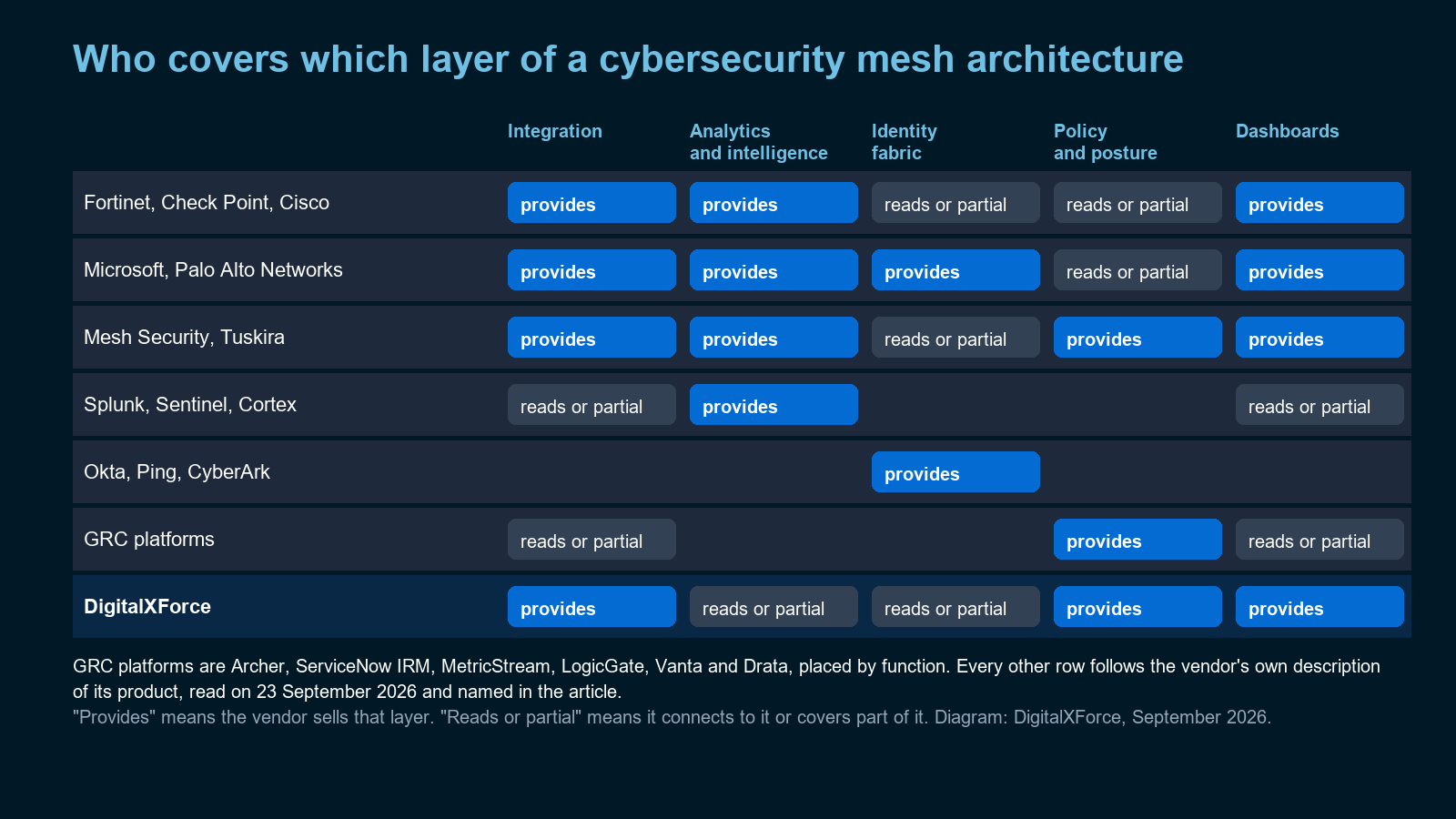
No vendor sells a whole cybersecurity mesh architecture, because a mesh is a way of connecting the tools an organization already runs. What vendors sell is one or more of its layers. This comparison places the vendors a buyer will meet on the four layers, using each vendor’s own description of its product, read on 23 September 2026. DigitalXForce is placed the same way.
How this comparison was made
The four layers are the ones in public summaries of Gartner’s research: security analytics and intelligence, a distributed identity fabric, consolidated policy and posture management, and consolidated dashboards, with the integration layer that connects them. They are explained in The Four Layers of a Cybersecurity Mesh Architecture. Each vendor’s row follows what that vendor says about itself on its own site, quoted below with the page named. Where a category comes from a third party, the third party is named. Half of the security leaders in Gartner’s Peer Community survey (50%) said a lack of vendors offering complete solutions was a barrier to the mesh, and this page is written for that buyer. Source: Gartner Peer Community.
The platform vendors: network and security suites that call themselves a mesh
Fortinet. Fortinet calls the Fortinet Security Fabric “the industry’s highest-performing cybersecurity mesh platform, powered by FortiOS” and says this type of protection “has existed for more than a decade through the Fortinet Security Fabric”. It covers network, endpoint and cloud enforcement with centralized analysis. Source: Fortinet Security Fabric.
Check Point. Check Point sells a CSMA assessment and consulting service: “Evaluate CSMA and Zero Trust maturity, identify key gaps, and gain a clear roadmap for building adaptive, business-aligned security architecture”, delivered in one to three days onsite with a report within four weeks, alongside its Infinity platform for network, cloud and endpoint enforcement. Source: Check Point CSMA assessment.
Cisco. Cisco describes its security portfolio as an “AI-native fabric unifying identity, network, cloud, and endpoint protection” with “policy, inspection, and enforcement at every connection”. Its pages do not use the term cybersecurity mesh architecture. Source: Cisco security.
Microsoft. Microsoft Sentinel is “a cloud-native SIEM solution” that “combines AI, automation, and threat intelligence to support threat detection, investigation, response, and proactive hunting”; with Entra ID, Defender and Intune, Microsoft covers analytics, identity and endpoint enforcement across its own estate. Source: Microsoft Learn.
Mesh Security and Tuskira. Both companies describe their products in mesh terms. Mesh Security describes its product as “purpose-built” and “vendor-agnostic”, with “Continuous Enterprise-Wide Visibility” and a “bring your own data lake” approach; it also publishes a categorization of CSMA vendors, which places itself, Check Point, Cisco, Fortinet, Google, IBM, Microsoft and Tuskira among full platforms. That categorization is Mesh Security’s own reading of Gartner’s 2025 research, not a Gartner list. Source: Mesh Security. Tuskira describes itself as “an AI-native security operations platform” with a semantic data layer normalizing 150+ tools and an analytics and intelligence layer. Source: Tuskira.
The layer specialists
Analytics and intelligence. Splunk, Microsoft Sentinel and Palo Alto Networks Cortex are the SIEM and security data lake. Palo Alto Networks calls Cortex “the single, autonomous platform for the modern SOC”, founded on “The Cortex Extended Data Lake. Collect once. Analyze infinitely to power all of security operations.” Source: Palo Alto Networks Cortex. These tools see events, not control state; they are the first layer, not the mesh.
Identity fabric. Okta describes the mesh as “a protected boundary around individual identities (human or device)” and its own role through its Identity Fabric and “centralized policy orchestration with localized enforcement”. Ping Identity, CyberArk, SailPoint, Saviynt and Delinea sit in the same layer. Source: Okta.
Policy and posture. This is where governance, risk and compliance platforms live by function: Archer, ServiceNow IRM, MetricStream, LogicGate, Vanta, Drata and their peers. None of them describes itself as a cybersecurity mesh architecture, and placing them here is DigitalXForce’s reading of the layer, not theirs. The difference between them is how much of the evidence they read from the tools and how much they collect from people; that is the question Cybersecurity Mesh Architecture for Compliance and Continuous Control Monitoring answers.
Where DigitalXForce fits
DigitalXForce is built on a cybersecurity mesh architecture and sells the policy, posture and dashboard layers for risk and compliance. It connects to the other layers through 250+ technology integrations; of the 136 with a logo on its integrations page on 23 September 2026, 9 are identity tools, 22 are analytics and threat intelligence tools and 60 are endpoint, network, vulnerability and application security tools. It tests the controls those tools enforce, maps each control once to 50+ compliance frameworks, and reports one posture score, the Digital Trust Score, with the evidence behind it.
DigitalXForce reads its evidence from the identity, enforcement and SIEM tools a company already has and does not replace them. DigitalXForce Lite is the full DigitalXForce platform hosted in the cloud, with the same functionality and a faster deployment, for any organization that prefers cloud hosting. DigitalXForce was built for a regulated enterprise that already runs many of the tools in this comparison and cannot prove, on any given day, that the controls across them are working.
Which layer each vendor describes on its own page
| Layer of the mesh | Vendors whose own pages describe it |
|---|---|
| Policy, posture and dashboards for risk and compliance | DigitalXForce |
| Security analytics and intelligence | Microsoft Sentinel, Palo Alto Networks Cortex, Mesh Security, Tuskira |
| Distributed identity fabric | Okta |
| Enforcement across network, endpoint and cloud | Fortinet, Check Point, Cisco |
Questions about mesh vendors
Which vendor sells a complete cybersecurity mesh architecture?
None does, because a mesh is a way of connecting the tools an organization already runs. Each vendor named on this page covers some of the layers. DigitalXForce sells the policy, posture and dashboard layers for risk and compliance and connects to the identity, analytics and enforcement layers through 250+ technology integrations. Half of the security leaders in Gartner's Peer Community survey named the lack of complete solutions as a barrier.
Is Fortinet Security Fabric a cybersecurity mesh architecture?
Fortinet calls it "the industry's highest-performing cybersecurity mesh platform" and says the protection has existed for more than a decade. By the four layers, it provides enforcement, analytics and dashboards across Fortinet products; the identity fabric and the compliance posture layer come from other vendors.
Which layer do GRC platforms belong to?
Consolidated policy and posture management, by function. Archer, ServiceNow IRM, MetricStream, LogicGate, Vanta and Drata do not describe themselves as a mesh; the difference between them is how much evidence they read from the tools and how much they collect from people.
Is DigitalXForce a full-stack cybersecurity mesh platform?
DigitalXForce sells the policy, posture and dashboard layers for risk and compliance. It connects to the identity, analytics and enforcement layers through 250+ technology integrations and does not replace them. The platform is built on a cybersecurity mesh architecture.
Does Gartner publish a list of cybersecurity mesh vendors?
Gartner's research on the mesh is available to Gartner clients. The vendor categorizations that circulate publicly, such as Mesh Security's 2025 overview, are those vendors' readings of Gartner's research and are named as such here.
What should a buyer check before choosing?
Which layer is the gap, and whether the candidate's own page describes that layer. A vendor that calls itself a mesh platform still has to be mapped to the layer you are missing. The APIs matter as much as the features: 38% of the leaders in Gartner's survey said tools with usable APIs were the hardest part of building a mesh.
See it on your own data
The fastest way to check DigitalXForce against your own program is a 30 minute walkthrough on your own frameworks and your own integrations. You leave with a mapped control set and a view of what Continuous Control Monitoring would surface in your environment.