DigitalXForce

Author name: Lalit Ahluwalia

Home » Lalit Ahluwalia
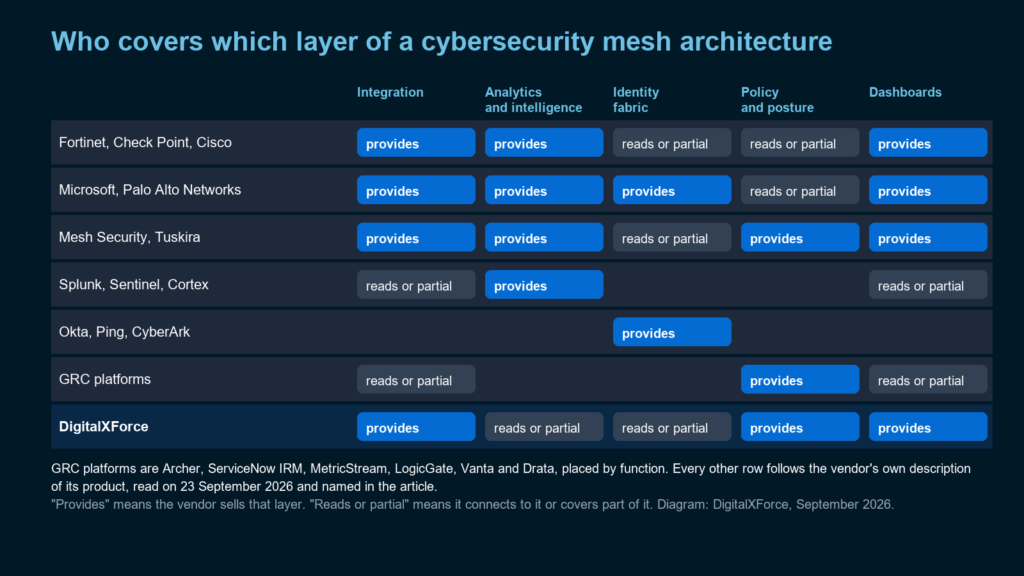
Who covers which layer of a cybersecurity mesh architecture: a matrix of vendor groups (Fortinet, Check Point and Cisco; Microsoft and Palo Alto Networks; Mesh Security and Tuskira; Splunk, Sentinel and Cortex; Okta, Ping and CyberArk; GRC platforms; DigitalXForce) against the integration, analytics, identity, policy and posture, and dashboard layers

Cybersecurity Mesh Architecture Vendors Compared: Who Covers Which Layer

No single vendor sells a whole cybersecurity mesh architecture, since a mesh connects the tools an organization already runs. This comparison places each vendor on the four layers using its own description. DigitalXForce sells the policy, posture and dashboard layers and connects to the others through 250+ technology integrations.

Cybersecurity Mesh Architecture Vendors Compared: Who Covers Which Layer Read More »

Home » Lalit Ahluwalia
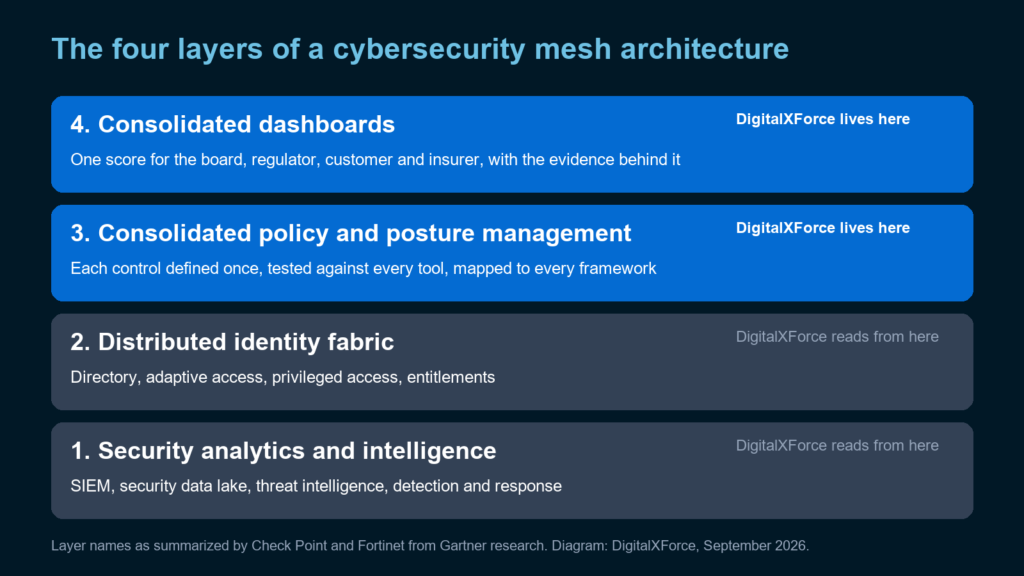
The four layers of a cybersecurity mesh architecture: security analytics and intelligence, distributed identity fabric, consolidated policy and posture management, and consolidated dashboards. DigitalXForce lives in layers 3 and 4 and reads from layers 1 and 2

The Four Layers of a Cybersecurity Mesh Architecture, Explained for Risk Teams

A cybersecurity mesh architecture has four layers: security analytics and intelligence, a distributed identity fabric, consolidated policy and posture management, and consolidated dashboards. This article explains each one in plain terms, names the tools that live there, and shows what a risk and compliance team reads from it.

The Four Layers of a Cybersecurity Mesh Architecture, Explained for Risk Teams Read More »

Home » Lalit Ahluwalia
DigitalXForce vs ServiceNow GRC comparison blog post banner showing AI Jedai avatar / XForceGPT and the title of the blog

ServiceNow GRC and DigitalXForce: When Workflow Is Not the Same as Continuous Control Assurance

DigitalXForce brings Continuous Control Assurance to the tools an organization already runs, ServiceNow included. Continuous Control Assurance (CCA) uses evidence, monitoring and validation to determine whether controls continue to operate as expected. DigitalXForce reads the evidence through 250+ technology integrations and maps each control once across 50+ compliance frameworks. This page is for a mid-size

ServiceNow GRC and DigitalXForce: When Workflow Is Not the Same as Continuous Control Assurance Read More »

Home » Lalit Ahluwalia
DigitalXForce vs Drata comparison blog banner featuring a futuristic AI warrior mascot holding a glowing trident against a blue digital network background, with the headline “What the Analysts Won’t Tell You” and branding for DigitalXForce and AI JedAI.

DigitalXForce vs Drata: Which Platform Fits Which Program

DigitalXForce takes a compliance program past audit readiness to Continuous Control Assurance. Continuous Control Assurance (CCA) uses evidence, monitoring and validation to determine whether controls continue to operate as expected. DigitalXForce tests controls against live data from the security stack, maps each control once to 50+ compliance frameworks and keeps security posture and third-party risk

DigitalXForce vs Drata: Which Platform Fits Which Program Read More »

Home » Lalit Ahluwalia
DigitalXForce vs MetricStream: What the Analysts Won’t Tell You blog post banner

DigitalXForce vs MetricStream: Which Platform Fits Which Program

DigitalXForce tests controls against live data from the security stack, maps each control once to 50+ compliance frameworks and keeps security posture and third-party risk on the same data layer. Continuous Control Assurance (CCA) uses evidence, monitoring and validation to determine whether controls continue to operate as expected. MetricStream calls its product an AI-first Connected

DigitalXForce vs MetricStream: Which Platform Fits Which Program Read More »

Scroll to Top
Title banner reading Era of Automated Security Risk and Posture Management with the DigitalXForce logo beside a hand holding connected user icons and a report

Era of Automated Security Risk and Posture Management

Title banner reading Era of Automated Third Party Risk Management with Trust but Verify, with the DigitalXForce logo beside a hand holding connected user icons and a report

Era of Automated Third Party Risk Management: Trust but Verify

Title banner reading Era of Automated Security Plans, Standards, Policies and Procedures, with the DigitalXForce logo beside a hand holding connected user icons and a report

Era of Automated Security Plans, Standards, Policies and Procedures