Start here: TRiSCM, Continuous Control Assurance and the research behind them
Read first, then see it on your own data
New to DigitalXForce? These four pages explain the category, the method and the evidence in the order a new reader needs them: what TRiSCM is, what Continuous Control Assurance adds to monitoring, the IDC research on DigitalXForce, and the glossary of every term the platform uses. This page is for security, risk and compliance leaders who prefer to read before they talk to anyone. The six documents below are DigitalXForce papers and IDC research, and the links here lead to the pages that explain the ideas behind them. Original data is on the DigitalXForce Research page.
What is TRiSCM
Trust, Risk, Security and Compliance Management, the category the papers describe, defined in one place.
What is Continuous Control Assurance
How controls are tested on live evidence so that a pass last quarter does not hide a failure today.
IDC research on DigitalXForce
The IDC recognitions and the excerpt of the IDC document, with the exact document numbers.
DigitalXForce Glossary
Every platform term used in the papers, defined once.
To check the ideas in these papers against your own controls, request a demo.

Digital Trust in the AI Era
By Margareta Petrovic, Chief AI Officer at DigitalXForce, May 2026, 5 pages.
It answers how a team keeps trust in AI models and vendors that change long before the next annual review.
Continuous Control Assurance (CCA) uses evidence, monitoring and validation to determine whether controls continue to operate as expected. Margareta Petrovic wrote Digital Trust in the AI Era for GRC, AI governance and third-party risk leaders whose AI models and vendors change long before the next annual review. The paper sets out five control domains with the evidence each one needs, and it ends with three steps a team can take within a week.
For the method itself, see Continuous Control Assurance. The Digital Trust Portal shows how DigitalXForce shares that view with boards, regulators and customers.

Powering AI Risk Governance with DigitalXForce
A DigitalXForce white paper, September 2025, 12 pages.
It answers how an enterprise should govern its AI against the NIST AI RMF, ISO/IEC 42001 and the EU AI Act.
AI governance is the set of policies, roles, controls and evidence an organization uses to decide which AI systems it runs, how they may be used and whether their controls keep working. Powering AI Risk Governance with DigitalXForce takes CISOs, CIOs and governance teams through five areas, beginning with an inventory of every AI asset. The paper ties that program to the NIST AI RMF, ISO/IEC 42001 and the EU AI Act.
To see how DigitalXForce handles AI risk, read AI TRiSCM and AI risk governance. The frameworks page shows which frameworks DigitalXForce maps controls to.


Never Trust, Always Verify: Addressing Third-Party Cyber Risk Exposures in the Era of Automation
A DigitalXForce white paper, March 2025, 43 pages.
It answers how far one supplier’s failure can reach and what an automated third-party risk program does about it.
Third-party risk management (TPRM) is the discipline of identifying, assessing, monitoring and controlling the risks an organization takes on through its suppliers, vendors and other outside parties. Never Trust, Always Verify uses eight public supply chain incidents from 2020 to 2024 to show how far one supplier’s failure can reach. The paper then lays out an automated TPRM program and is written for the IT, security, procurement and legal teams who share the job.
The AI-Powered Third-Party Risk Management page shows how the DigitalXForce platform supports a TPRM program, and External Risk View assesses a supplier without a questionnaire.

Redefining the Future of Cybersecurity With Digital Trust
By Lalit Ahluwalia and Desiree Wilson of DigitalXForce, 2023, 25 pages.
It answers what Digital Trust is and where a security leader starts building it.
Digital Trust translates connected assurance and risk evidence into an enterprise-level view for decision-makers. Redefining the Future of Cybersecurity With Digital Trust adds trust as a fourth tenet of cybersecurity, alongside confidentiality, integrity and availability. Lalit Ahluwalia and Desiree Wilson describe what Digital Trust rests on, including integrated risk management and continuous monitoring, and they give security leaders seven steps to start building it.
Trust, Risk, Security and Compliance Management is defined on the What is TRiSCM page. The Enterprise Security Risk and Posture Management (ESRPM) page describes the DigitalXForce module that runs configuration checks across an organization’s security tools.
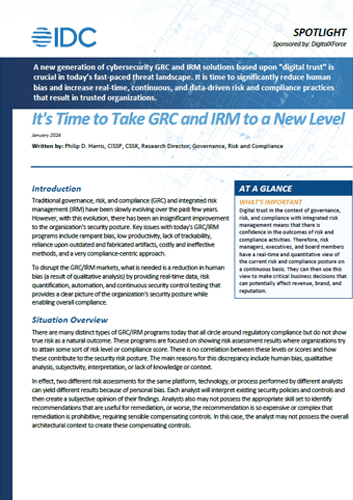
IDC Spotlight: It Is Time to Take GRC and IRM to a New Level
IDC Spotlight document US51751024, sponsored by DigitalXForce, January 2024, 7 pages. DigitalXForce lists its IDC recognitions, with their document numbers, on the IDC research page.