DigitalXForce

Security Posture Management

Articles on security posture across cloud, identity, applications, OT and IoT: attack surface, configuration and exposure, and the Enterprise Security Risk and Posture Management (ESRPM) module.

Home » Security Posture Management
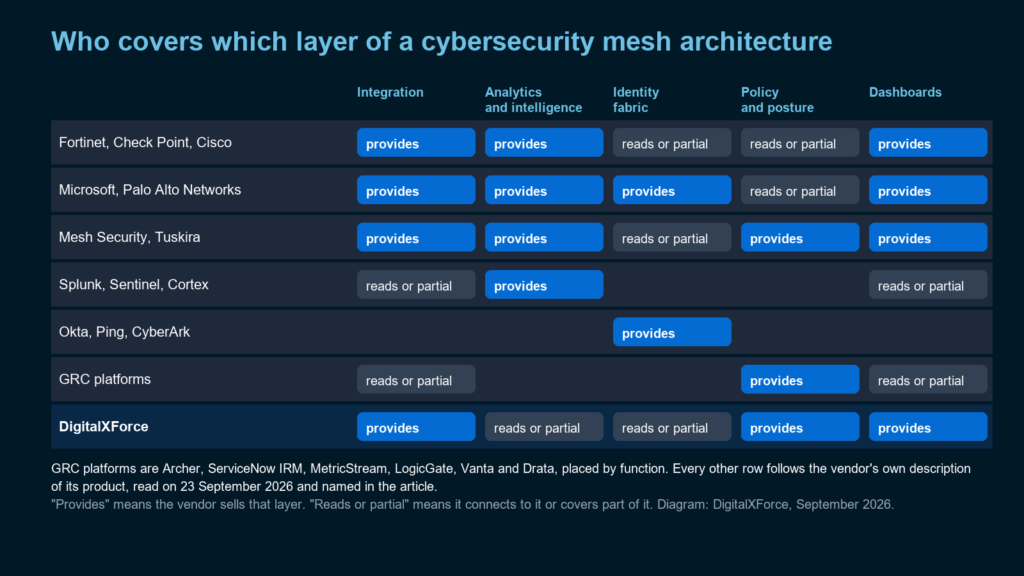
Who covers which layer of a cybersecurity mesh architecture: a matrix of vendor groups (Fortinet, Check Point and Cisco; Microsoft and Palo Alto Networks; Mesh Security and Tuskira; Splunk, Sentinel and Cortex; Okta, Ping and CyberArk; GRC platforms; DigitalXForce) against the integration, analytics, identity, policy and posture, and dashboard layers

Cybersecurity Mesh Architecture Vendors Compared: Who Covers Which Layer

No single vendor sells a whole cybersecurity mesh architecture, and the ones that come closest are network and platform companies. This comparison places each vendor on the four layers using its own description, names where DigitalXForce fits and where it does not, and gives a buyer a way to choose by situation.

Cybersecurity Mesh Architecture Vendors Compared: Who Covers Which Layer Read More »
Home » Security Posture Management
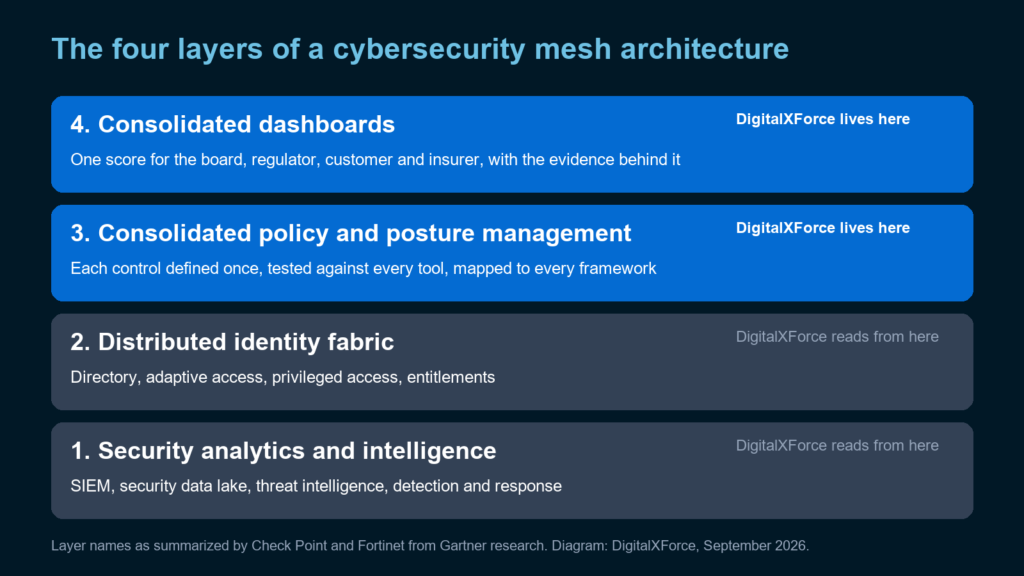
The four layers of a cybersecurity mesh architecture: security analytics and intelligence, distributed identity fabric, consolidated policy and posture management, and consolidated dashboards. DigitalXForce lives in layers 3 and 4 and reads from layers 1 and 2

The Four Layers of a Cybersecurity Mesh Architecture, Explained for Risk Teams

A cybersecurity mesh architecture has four layers: security analytics and intelligence, a distributed identity fabric, consolidated policy and posture management, and consolidated dashboards. This article explains each one in plain terms, names the tools that live there, and shows what a risk and compliance team reads from it.

The Four Layers of a Cybersecurity Mesh Architecture, Explained for Risk Teams Read More »

Home » Security Posture Management
Risk-Resilience Integration with Enterprise Security Posture Management

Risk-Resilience Integration with Enterprise Security Posture Management

Risk and Resilience Integration with Enterprise Security Posture Management represents a critical advancement in addressing the complex digital security challenges facing modern organizations. The integration of risk management and resilience frameworks with security posture management provides a transformative approach to how organizations protect their digital assets, respond to threats, and maintain business continuity in the

Risk-Resilience Integration with Enterprise Security Posture Management Read More »

Home » Security Posture Management
Cryptographic Trust Erosion in API Interconnectivity | DigitalXForce

Cryptographic Trust Erosion in API Interconnectivity

Application Programming Interfaces (API) have become the silent arteries of our digital ecosystem, transmitting critical information across organizational boundaries with seemingly effortless precision. Modern digital infrastructure involves an intricate network of technological connections that pulse with data, yet remain largely invisible to the naked eye.  Beneath this seamless facade lies a complex and increasingly precarious

Cryptographic Trust Erosion in API Interconnectivity Read More »

Home » Security Posture Management
Assessing the Security of Your Cloud Service Providers: A Guide for Businesses blog post banner image

Assessing the Security of Your Cloud Service Providers: A Guide for Businesses

Cloud service providers (CSPs) have become the backbone of modern business operations in today’s digital landscape through cloud computing. From storing sensitive data to running critical applications, companies of all sizes increasingly rely on CSPs to power their operations. But here’s the million-dollar question: How secure are these cloud services?

Assessing the Security of Your Cloud Service Providers: A Guide for Businesses Read More »

Home » Security Posture Management
Ensuring Security Trust with Secure Software Development Life Cycle blog post banner

Ensuring Security Trust with Secure Software Development Life Cycle

The Secure Software Development Life Cycle (SSDLC) is a comprehensive framework designed to integrate security practices into each phase of software development. By embedding security considerations from the outset, organizations can create software resilient to attacks and capable of safeguarding sensitive information. This article provides an overview of the SSDLC, highlights its importance, and outlines

Ensuring Security Trust with Secure Software Development Life Cycle Read More »

Home » Security Posture Management
healthcare data security in a multi-cloud environment image

Healthcare Data Security in a Multi-Cloud Environment

The healthcare industry has embraced cloud computing to drive agility, scalability, and cost efficiencies. However, using multi-cloud service providers (mCSPs) introduces complexities in consistently securing sensitive data across different platforms and architectures, impacting healthcare data security.  A fragmented multi-cloud approach can lead to gaps in security policies, inconsistent access controls, and a disjointed view of

Healthcare Data Security in a Multi-Cloud Environment Read More »

Home » Security Posture Management
Enhancing Container Security with Proactive Vulnerability Management banner image

Enhancing Container Security with Proactive Vulnerability Management

Containerisation has revolutionised software development and deployment, providing unparalleled versatility and scalability. Still, this change in perspective also brings unique security challenges.  This comprehensive analysis will thoroughly examine container security from all perspectives, providing the necessary understanding to protect your containerised environments. Containerisation: A Fundamental Shift in Application Delivery Containerization is a form of operating

Enhancing Container Security with Proactive Vulnerability Management Read More »

Scroll to Top