DigitalXForce takes a compliance program past audit readiness to Continuous Control Assurance. Continuous Control Assurance (CCA) uses evidence, monitoring and validation to determine whether controls continue to operate as expected. DigitalXForce tests controls against live data from the security stack, maps each control once to 50+ compliance frameworks and keeps security posture and third-party risk on the same data layer. Drata describes its product as a compliance automation platform, and the rest of this article compares that description with how DigitalXForce does the work.
The short answer, by situation
| If this is you | Look at first |
|---|---|
| You would rather have the platform hosted in the cloud, or you are preparing for your first SOC 2 attestation with no broader compliance program to run yet | DigitalXForce Lite |
| You run on AWS, Azure or GCP and want each cloud account’s configuration findings mapped to the controls they affect | DigitalXForce |
| Your auditors or regulators want proof that controls worked between audits, across the whole security stack | DigitalXForce |
| You report against many frameworks and want each control mapped once and the evidence reused | DigitalXForce |
| You want security posture, third-party risk and compliance on one record | DigitalXForce |
DigitalXForce wrote this comparison, so read it knowing that. Every statement about Drata below is Drata’s own description of its product. Every statement about DigitalXForce comes from its product pages and follows the same template, limitations included. Neither vendor reviewed the text. The vendor research was done on 19 September 2026 and checked against the vendor pages again on 25 September 2026, and the sources are listed at the end.
What each platform is
Drata. Drata describes its product as a cloud-based compliance automation platform. Drata says the platform connects to cloud infrastructure, identity providers, HR systems and code repositories, runs automated control tests such as MFA enforcement, encryption and access reviews, and collects evidence for audits. Drata says on its own site that it supports 30+ frameworks.
DigitalXForce. DigitalXForce is the AI-native Enterprise Trust, Risk, Security and Compliance Management (TRiSCM™) platform unifying automated GRC and security posture management. Its AI-Powered Risk Management and Automated GRC module runs continuous control monitoring against the organization’s security stack, maps each control once to a library of 50+ compliance frameworks, and reuses the evidence across all of them. Security posture management, third-party risk with an External Risk View, AI risk governance and risk operations run on the same platform and the same data layer, so one failed control result reaches the compliance view, the posture view and the risk register at the same time. The platform is built on a Cybersecurity Mesh Architecture and connects to the tools a security team already runs through 250+ technology integrations. DigitalXForce runs two AI engines. AI JedAI analyzes the evidence, and XForce GPT writes the risk narratives and board-ready reports.
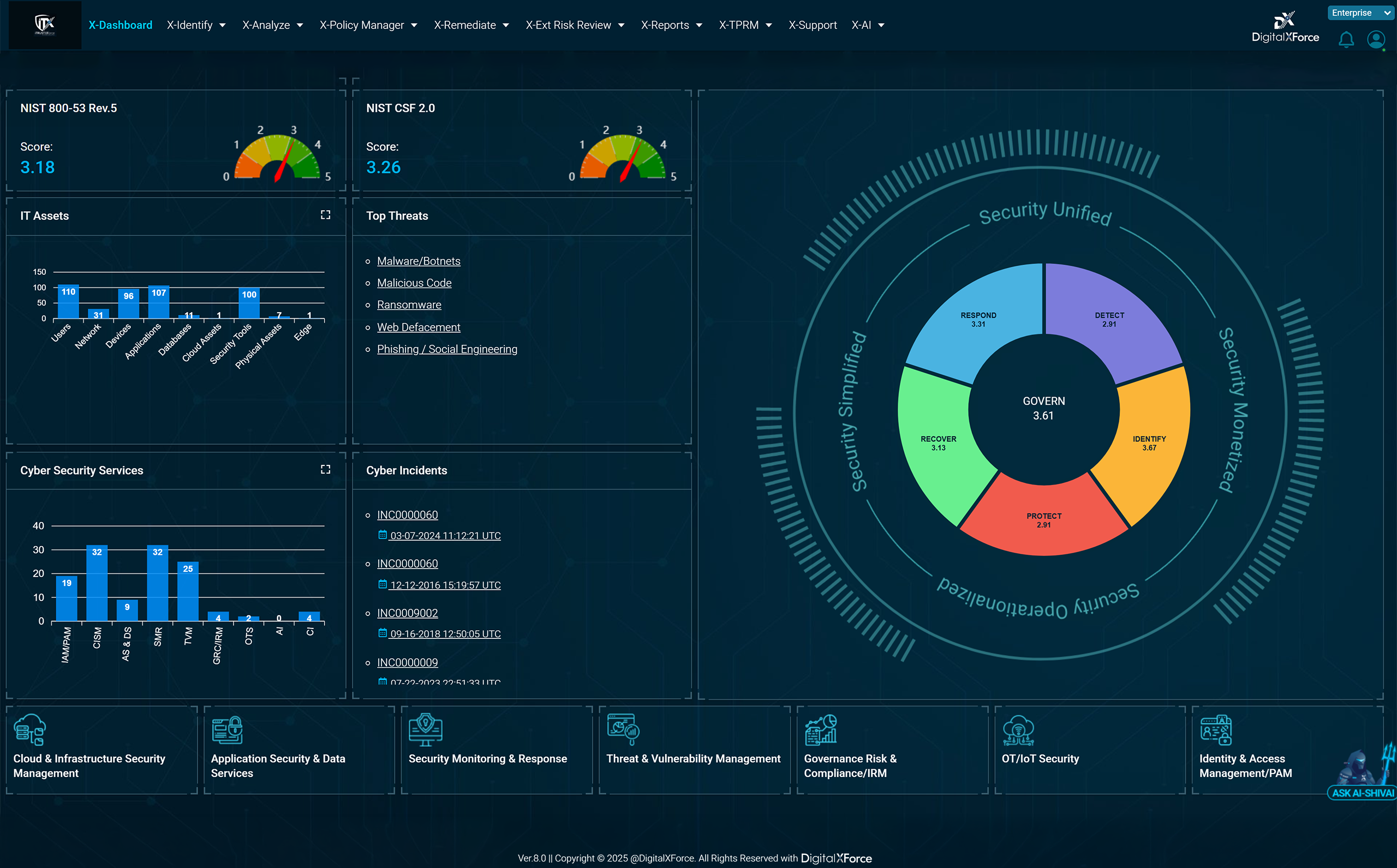
Side by side
| Drata | DigitalXForce | |
|---|---|---|
| Category | Compliance automation | Trust, Risk, Security and Compliance Management (TRiSCM) |
| Where control evidence comes from | Continuous tests against connected cloud, identity, HR and code systems | Live data from the security stack, tested continuously between audits |
| Frameworks | 30+, per Drata’s own site | 50+ compliance frameworks, each control mapped once and the evidence reused |
| Integrations | Listed on Drata’s integrations page | 250+ technology integrations through the X-Connect and E-Connect adapters |
| Security posture and third-party risk | Third-Party Risk Management with AI vendor reviews, and CSPM and endpoint integrations, per Drata’s own pages | Security posture management and Third-Party Risk Management with External Risk View on the same data layer |
| Analyst recognition | Listed by IDC among the companies covered in the IDC MarketScape: Worldwide Third-Party Risk Management Software 2026 Vendor Assessment; its category is not on IDC’s public page | Leader, IDC MarketScape: Worldwide Governance, Risk, and Compliance Software Vendor Assessment, 2025 (Doc #US53615325, June 2025); Leader, IDC MarketScape: Worldwide Third-Party Risk Management Software 2026 Vendor Assessment (Doc #US53007725, September 2026) |
Where DigitalXForce goes further
DigitalXForce goes further when audit readiness is no longer the whole question. A regulated enterprise usually reports against many frameworks, runs security tooling beyond the cloud and SaaS estate, and has to show its board that controls kept working between audits. The DigitalXForce AI-Powered Risk Management and Automated GRC module runs three assessment modalities, C-Assess, X-Assess and A-Assess, and maps each control once to 50+ compliance frameworks through the X-Connect and E-Connect adapters. Evidence collected for a control is reused wherever that control is mapped.
DigitalXForce also fits when compliance, security posture and vendor risk need to sit on one record. The 15 DigitalXForce modules share one data layer, so one failed control result reaches the compliance view, the posture view and the risk register at the same time. DigitalXForce gives every vendor its own score, built from its questionnaire answers, its evidence and external signals.
Where DigitalXForce is not the answer
DigitalXForce Lite runs the same platform in the cloud for any organization that prefers cloud hosting, including a company preparing its first SOC 2 attestation with no broader compliance program to run yet. DigitalXForce Lite is the full DigitalXForce platform hosted in the cloud, with the same functionality and a faster deployment, for any organization that prefers cloud hosting. DigitalXForce prepares a company for SOC 2, and an independent CPA firm issues the SOC 2 report itself.
DigitalXForce lets a prospective client run a cloud deployment, so the client sees the platform work first hand before buying. Public Gartner Peer Insights reviews of DigitalXForce are collected on DigitalXForce’s testimonials page.
Questions to ask both vendors in a demo
- Ask which controls are tested against live data today and which still rely on an uploaded document.
- Ask how a control that appears in several frameworks is mapped, and whether the evidence is collected once.
- Ask how systems outside the cloud and SaaS estate are covered, such as on-premises infrastructure and security tooling.
- Ask where third-party risk evidence comes from and whether it sits on the same record as internal controls.
- Ask when the first assessments on your own systems will run. In a DigitalXForce proof of value, they run in week 3 and are reviewed with you in week 4.
- Ask whether you can run a deployment and see the platform work on your own systems before you buy.
How continuous control monitoring works across a security stack is explained in Cybersecurity Mesh Architecture for Compliance and Continuous Control Monitoring, and every term used above is in the DigitalXForce glossary. Buyers who are choosing between compliance automation platforms can also read how DigitalXForce compares with Vanta.
Frequently asked questions
Is Drata a GRC platform?
Drata describes its product as a compliance automation platform, and its AWS Marketplace listing calls it governance, risk and compliance automation. DigitalXForce is the AI-native Enterprise Trust, Risk, Security and Compliance Management (TRiSCM) platform unifying automated GRC and security posture management. It runs Continuous Control Assurance across 50+ compliance frameworks with security posture and third-party risk on the same data layer.
Is DigitalXForce a good alternative to Drata for SOC 2?
DigitalXForce treats SOC 2 as one framework inside Continuous Control Assurance and maps each SOC 2 control once to 50+ compliance frameworks, so the evidence collected for SOC 2 is reused for the other frameworks. For a company preparing its first SOC 2 attestation, DigitalXForce Lite is the full DigitalXForce platform hosted in the cloud, with the same functionality and a faster deployment, for any organization that prefers cloud hosting. DigitalXForce prepares a company for SOC 2, and an independent CPA firm issues the SOC 2 report itself.
Does Drata do continuous control monitoring?
Drata says it runs continuous control tests, such as MFA enforcement, encryption and access reviews, against the cloud, identity, HR and code systems it connects to. DigitalXForce runs continuous control monitoring against the organization’s security stack and maps each result once to 50+ compliance frameworks. Continuous Control Monitoring (CCM) monitors conditions, evidence and signals associated with controls. In DigitalXForce, Continuous Control Monitoring is a capability within Continuous Control Assurance. Continuous Control Assurance (CCA) uses evidence, monitoring and validation to determine whether controls continue to operate as expected. The useful question for both is which of your controls are tested against live data.
How many frameworks do Drata and DigitalXForce support?
Drata’s own site says it supports 30+ frameworks. DigitalXForce maps each control once to 50+ compliance frameworks through the X-Connect and E-Connect adapters and reuses the evidence wherever that control is mapped.
Can I run DigitalXForce before I buy it?
DigitalXForce lets a prospective client run a cloud deployment, so the client sees the platform work first hand before buying. In a demo, a buyer can ask when the first assessments of a proof of value will run, and in a DigitalXForce proof of value they run in week 3 and are reviewed with the customer in week 4.
Sources
- AWS Marketplace, Drata listing
- AWS Marketplace, Drata compliance automation listing
- AWS Partner Network blog, Drata continuous compliance on AWS
- Drata, platform page
- Drata, integrations
- IDC MarketScape: Worldwide Governance, Risk, and Compliance Software Vendor Assessment, 2025, excerpt hosted by DigitalXForce (PDF)
- IDC MarketScape: Worldwide Third-Party Risk Management Software 2026 Vendor Assessment, IDC document page
- Gartner Peer Insights, DigitalXForce, read 18 September 2026
See it on your own data
The fastest way to check DigitalXForce against your own program is a 30 minute walkthrough on your own frameworks and your own integrations. You leave with a mapped control set and a view of what Continuous Control Monitoring would surface in your environment. Request a demo.