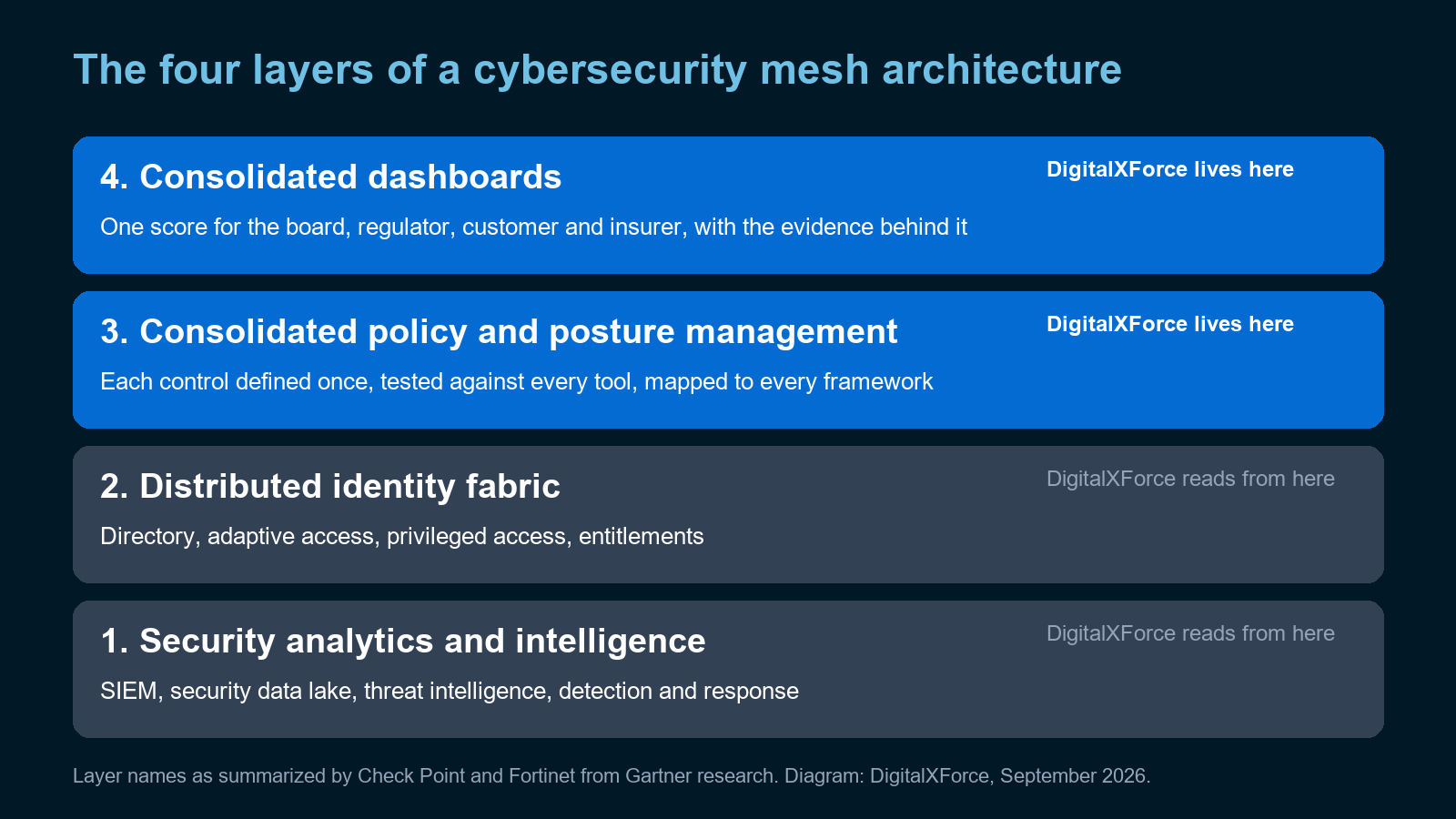
A cybersecurity mesh architecture has four foundational layers: security analytics and intelligence, a distributed identity fabric, consolidated policy and posture management, and consolidated dashboards. Most explanations of the layers are written for security architects. This one is written for the risk, compliance and audit team that has to prove the controls in each layer are working, because that is where the mesh pays off or fails.
The layer names below follow the public summaries by Check Point and Fortinet, which attribute them to Gartner’s research; the Gartner document itself is available to Gartner clients. Gartner’s own public statement is its press release of 18 October 2021, which describes the mesh as helping “provide an integrated security structure and posture to secure all assets, regardless of location.” The definition and the risk and compliance case are on the DigitalXForce page Cybersecurity Mesh Architecture for Risk and Compliance.
One fact from DigitalXForce’s own integrations page shows how the layers are populated in practice. Of the 136 technology integrations shown there on 23 September 2026, 9 are identity and access tools (layer 2), 22 are analytics, logging and threat intelligence tools (layer 1), 60 are endpoint, network, vulnerability and application security tools whose posture is read into layer 3, and 45 are cloud, development and enterprise systems that hold controls of their own. The platform’s full count is 250+ technology integrations; these 136 are the ones with a logo on the page.
Layer 1. Security analytics and intelligence
This is the layer that collects data from the other tools, analyzes threats and triggers responses. In most enterprises it is the SIEM or the security data lake: Splunk, Microsoft Sentinel, Google SecOps, Elastic, plus the threat intelligence feeds that enrich them.
What a risk team reads from it: whether detection controls exist and fire. Log coverage, alert volumes, mean time to detect and the list of systems that send nothing are all compliance evidence, and every framework from SOC 2 to DORA asks for them.
The common mistake: treating the SIEM as the whole mesh. It sees events, not control state. It can tell you that a login failed 400 times; it cannot tell you whether multi-factor authentication is enforced on the account, because that is configuration, which lives in layer 3.
Layer 2. The distributed identity fabric
Directory services, adaptive access, identity proofing, decentralized identity and entitlement management. Okta, Microsoft Entra ID, Ping Identity, SailPoint, Saviynt, CyberArk and Delinea live here. It is the layer that Zero Trust depends on, which is why the Gartner Peer Community survey of 200 security leaders (November 2022 to January 2023) found that building a common identity fabric was among the hardest parts of a mesh for 34% of respondents.
What a risk team reads from it: the access controls that appear in every framework. Who has privileged access, whether MFA is enforced, how quickly leavers lose access, and whether entitlements are reviewed on schedule.
The common mistake: attesting to access controls on a questionnaire once a year while the identity provider could answer the question every hour. A mesh makes the identity fabric a source of evidence, not a screenshot.
Layer 3. Consolidated policy and posture management
This is the layer that turns a central policy into the configuration of individual tools and reports the resulting posture. It is where a risk and compliance platform belongs. A control is defined once, tested against each tool that enforces it, and mapped to every framework that requires it. That test, run on a schedule against live system state, is how Continuous Control Assurance validates the control. Continuous Control Assurance (CCA) uses evidence, monitoring and validation to determine whether controls continue to operate as expected. Continuous Control Monitoring (CCM) monitors conditions, evidence and signals associated with controls. CCM is a capability within CCA.
What a risk team reads from it: everything. Control pass and fail results with a date, framework coverage, posture by domain, and the gap list. In the DigitalXForce platform this layer is the Automated GRC module with its three assessment modalities, the ESRPM module for configuration and deployment benchmarking, and the posture engine, Extended Security Posture Management (X-SPM), which scores the evidence.
The common mistake: buying a posture tool per domain (cloud, identity, endpoint, data) and ending up with four posture scores that do not add up. Consolidated means one control library and one score, with domain views underneath it.
Layer 4. Consolidated dashboards
One view across the security tools, so that teams respond faster and leadership sees one picture. For a board, a regulator, a customer or an insurer, this is the layer that produces a single score and the evidence behind it. In the DigitalXForce platform it is the Digital Trust Score, a composite of seven sub-postures, shared through the Digital Trust Portal, and X-ROC, the XForce Risk Operations Center, where control failures and risk changes are alerted, triaged and escalated.
What a risk team reads from it: the number it reports. The mistake at this layer is a dashboard that is a picture of the other three layers rather than a product of them. If a board score cannot be traced back to a tool, a control and a date, it is a chart, not a dashboard.
The four layers in one table
| Layer | Typical tools | What a risk team reads from it | Where DigitalXForce sits |
|---|---|---|---|
| Security analytics and intelligence | Splunk, Microsoft Sentinel, Google SecOps, Elastic, threat feeds | Detection coverage, alert handling, systems that send nothing | Reads from it; adds AI JedAI analysis and External Risk View signals |
| Distributed identity fabric | Okta, Microsoft Entra ID, Ping Identity, SailPoint, Saviynt, CyberArk, Delinea | MFA enforcement, privileged access, leaver access, entitlement reviews | Reads from it; does not provide it |
| Consolidated policy and posture management | GRC and posture platforms | Control results with dates, framework coverage, posture by domain, the gap list | Lives here: Automated GRC, ESRPM, X-SPM |
| Consolidated dashboards | Reporting layers of the tools above | The one number reported to the board and the evidence behind it | Lives here: Digital Trust Score, Digital Trust Portal, X-ROC |
Where DigitalXForce is not the answer
Layers 1 and 2 are not what DigitalXForce sells. An organization without a working SIEM should get one from Splunk, Microsoft or Google. An organization whose identity fabric is fragmented should fix it with Okta, Microsoft Entra ID or Ping Identity before it measures anything. DigitalXForce connects to those layers through 250+ technology integrations and gives them a policy, posture and dashboard layer to report into. A company with a small stack and a first certification does not need all four layers, and DigitalXForce Lite serves that case in the cloud, with the same functionality as the full platform and a faster deployment.
How to use the layers when you plan
- Map your tools to the four layers. Most enterprises find layers 1 and 2 well populated, layer 3 split across spreadsheets and point tools, and layer 4 rebuilt by hand every quarter.
- Pick the controls that layer 3 will test first: the ones that appear in the most frameworks and can be read from a tool you already run.
- Decide the one number layer 4 will report, and what feeds it. If it is not traceable to layers 1 to 3, change the number.
- Add tools by their APIs. The Peer Community survey found that buying point tools with usable APIs was the hardest part of building a mesh for 38% of respondents, so integration is a purchasing criterion, not an afterthought.
Questions about the layers
What are the four layers of a cybersecurity mesh architecture?
Security analytics and intelligence; a distributed identity fabric; consolidated policy and posture management; and consolidated dashboards. Public summaries by Check Point and Fortinet attribute the four foundational layers to Gartner's research.
Which layer does a GRC or risk and compliance platform belong to?
Consolidated policy and posture management, with output to the consolidated dashboards. That is where a control is defined once, tested against each tool and mapped to every framework, and where the posture is scored.
Is a SIEM a cybersecurity mesh architecture?
No. A SIEM is the security analytics and intelligence layer. It sees events, not control state. A mesh needs the other three layers as well, in particular the policy and posture layer that knows whether a control is configured and working.
Which layer does Zero Trust depend on?
The distributed identity fabric most of all, because Zero Trust verifies every access. The policy and posture layer then tests that the Zero Trust controls are enforced across every tool. The comparison between the two is in the DigitalXForce article Cybersecurity Mesh Architecture vs Zero Trust.
Do I need all four layers before the mesh works?
No. Most organizations already have layers 1 and 2. The mesh starts paying off when layer 3 connects to them and tests controls from live data, and when layer 4 reports one number that traces back to those tests.
Which layers does DigitalXForce cover?
Consolidated policy and posture management (Automated GRC, ESRPM and the X-SPM posture engine) and consolidated dashboards (the Digital Trust Score, the Digital Trust Portal and X-ROC). It connects to the analytics and identity layers through 250+ technology integrations and does not replace them.
What this looks like in practice
Reading about continuous evidence is one thing. Watching a control get tested against live data from your own stack is another. A 30 minute walkthrough on your frameworks shows the difference.