A compliance program built on a cybersecurity mesh architecture does one thing differently: it reads evidence from the tools instead of asking people for it. Each control is defined once, tested against the live state of the system that enforces it, and the result is mapped to every framework that requires that control. The audit becomes an output of continuous control assurance rather than a separate collection exercise.
The problem the mesh solves for compliance
Most risk and compliance teams are asked to prove continuous oversight with the staff they had for annual reviews. The evidence for a SOC 2, an ISO 27001 certificate or a DORA assessment is collected from system owners as screenshots, exports and attestations, at the interval the audit sets. Between collections the organization works from a picture of the past, and every extra framework adds another round of collection for controls that were already collected for the last one. Gartner’s Peer Community survey of 200 security leaders, run between November 2022 and January 2023, found that the difficulty of managing security tools drove 41% of mesh adoption decisions, second only to the complexity of threats. The source is Gartner Peer Community.
What Continuous Control Monitoring is
Continuous Control Monitoring (CCM) monitors conditions, evidence and signals associated with controls. Continuous Control Assurance (CCA) uses evidence, monitoring and validation to determine whether controls continue to operate as expected. CCM is a capability within CCA. A control has four things: a source of evidence, a test, a frequency and an owner. A failed test raises a risk with an owner rather than a finding to be filed.
Continuous Control Monitoring, or CCM, is only possible when the platform is connected to the tools that hold the controls. That connection is the integration layer of the mesh, and the testing and mapping is its consolidated policy and posture layer. The layers are explained in The Four Layers of a Cybersecurity Mesh Architecture, and the definition of the mesh itself is on Cybersecurity Mesh Architecture for Risk and Compliance.
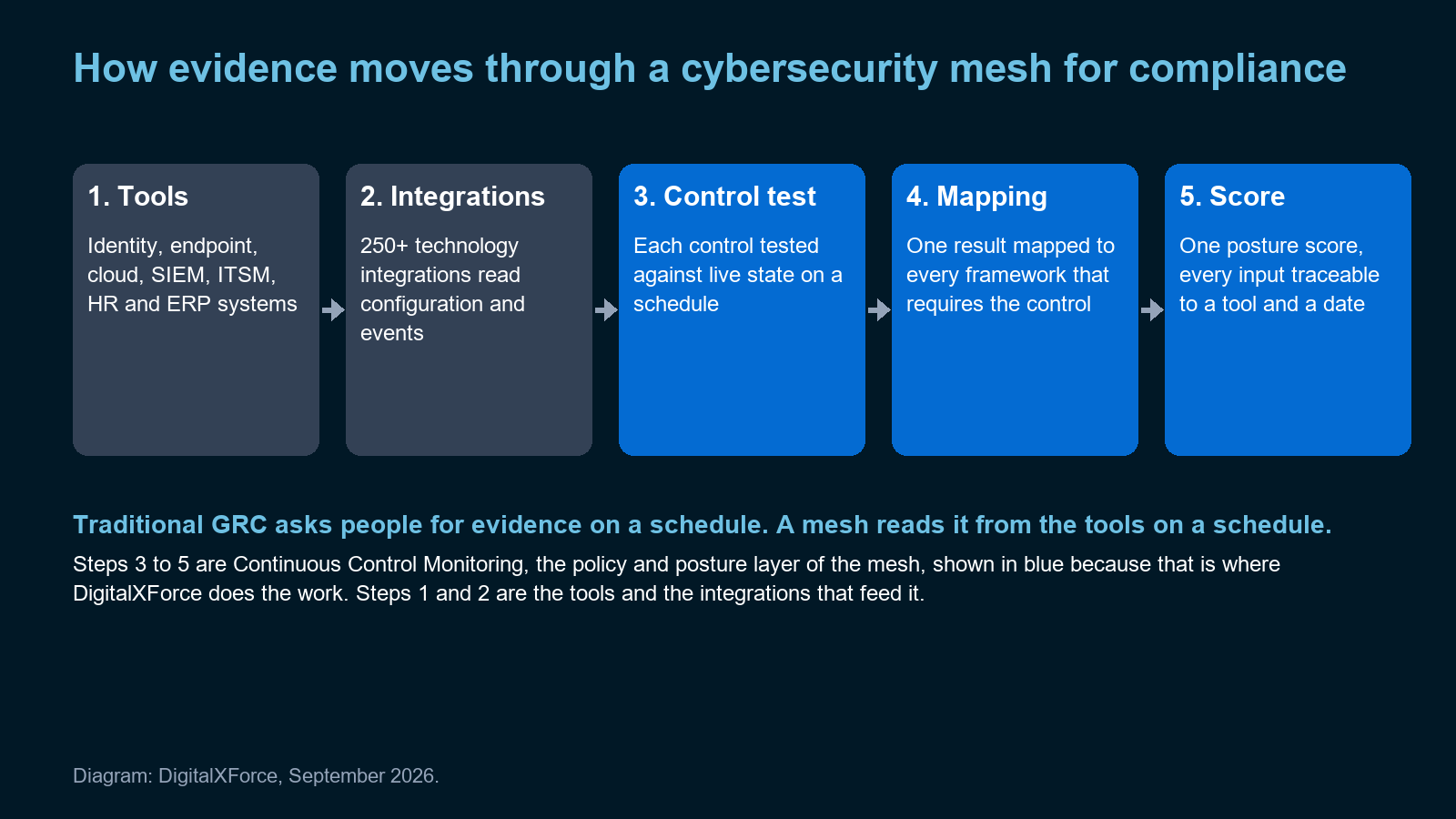
How evidence moves through the mesh, in five steps
- The tools hold the controls: the identity provider enforces MFA, the endpoint tool enforces device compliance, the cloud platform enforces encryption at rest, the ITSM tool records change approvals.
- The integration layer reads them. DigitalXForce reads configuration and events through 250+ technology integrations, through the X-Connect adapters for security tools and the E-Connect adapters for enterprise systems.
- Each control is tested against what the tool reports, on its frequency. If MFA is enforced for all users, the result is a pass with the date. If three service accounts lack MFA, the result is a fail with the account names.
- One result is mapped to every framework that requires the control. An MFA test serves SOC 2, ISO 27001, NIST CSF, PCI DSS, HIPAA and DORA at once.
- The results roll up into one posture score, and every input is traceable to a tool, a control and a date. The Digital Trust Score is DigitalXForce’s composite score from 300 to 850, computed continuously from live control evidence across seven sub-postures: security, compliance, audit, resilience, third-party, AI and risk.
Why mapping once matters across 50+ compliance frameworks
DigitalXForce maps controls to 50+ compliance frameworks. The frameworks page shows the 37 most requested with a badge each, and on 23 September 2026 they sort into five groups: 9 US federal and public sector frameworks (CMMC Level 1 and Level 2, NIST SP 800-171, FedRAMP, FISMA, MARS-E, the ATO risk criteria, IRS Publication 1075 and the NIST Privacy Framework), 6 US industry and healthcare frameworks (HITRUST, HIPAA, GLBA, FFIEC, the Cyber Risk Institute profile and SOC 2), 4 international standards (ISO 27001, CIS, the Secure Controls Framework and PCI DSS), 4 European Union regulations (DORA, NIS 2 and GDPR at two levels), and 14 Middle East frameworks (SAMA, NESA, the Saudi NCA controls including ECC, DCC, CSCC, TCC and CCC, ADHICS, CST, CRF, the Qatar frameworks QCSF and NIA, ISR and ADGM).
A regulated enterprise that operates in two of those jurisdictions reports against a dozen of these at once, and most of the controls overlap. Encryption at rest, MFA, least privilege, logging, vendor due diligence and incident response appear in nearly all of them. Collected once per framework, that is a dozen collections a year. Tested once and mapped, it is one test.
What stays with people, and where the mesh fits
A control that no tool can read, such as a background check or a board review, is still attested by a person. The platform records the attestation with its date and owner. XForce GPT drafts policies, standards and plans, and an analyst reviews the AI output before anyone relies on it. A weak control shows up at its next test instead of at the next audit, and its finding closes only when a retest passes. The auditor still issues the audit opinion and receives evidence with a timestamp instead of a screenshot with a story.
The mesh reads from the tools a company already runs, such as the identity provider and the SIEM. DigitalXForce connects to those tools through 250+ technology integrations and does not replace them. DigitalXForce Lite is the full DigitalXForce platform hosted in the cloud, with the same functionality and a faster deployment, for any organization that prefers cloud hosting. The mesh fits an organization that reports against several frameworks, runs many security and enterprise tools, and answers to a board or a regulator on a continuing basis.
How to start
- Pick the ten controls that appear in the most frameworks you report against. MFA, privileged access, encryption at rest, logging, patching, backup, vendor due diligence, access reviews, change management and incident response cover most of the overlap.
- Name the tool that enforces each one and connect it. A control with no tool is attested for now and flagged.
- Set the test, the frequency and the owner for each control, and map it to every framework once.
- Run the tests and read the gap list. Fix in the order of risk, not in the order of the audit calendar.
- Report the score to the board on the cadence of the tests, and hand the auditor the evidence trail rather than a folder of screenshots.
Questions about the mesh and compliance
What does a cybersecurity mesh architecture change for compliance?
Evidence comes from the tools through the integration layer instead of from people on a schedule. Each control is tested against live system state, the test result is the evidence, and one result maps to every framework that requires the control. Compliance becomes an output of Continuous Control Assurance, built on Continuous Control Monitoring.
What is Continuous Control Monitoring?
Continuous Control Monitoring (CCM) monitors conditions, evidence and signals associated with controls. Continuous Control Assurance (CCA) uses evidence, monitoring and validation to determine whether controls continue to operate as expected. CCM is a capability within CCA. A control has a source of evidence, a test, a frequency and an owner.
Does Continuous Control Monitoring need a cybersecurity mesh architecture?
It needs the integration layer of one. A control can only be tested continuously if the platform is connected to the tool that enforces it. The policy and posture layer of the mesh is where the testing and the framework mapping happen.
How many frameworks can one control test serve?
It serves every framework that requires that control. DigitalXForce maps controls to 50+ compliance frameworks; the 37 shown on its frameworks page span US federal, US industry, international, European Union and Middle East requirements, and controls such as MFA, encryption at rest and logging appear in nearly all of them.
What still has to be attested by a person?
Controls that no tool can read still need a person, such as background checks, board reviews, training completion in some organizations and physical security walkthroughs. The platform records those attestations with a date and an owner beside the tested controls, so the auditor sees one evidence trail.
Does the mesh replace the auditor?
It does not. It changes what the auditor receives: evidence with a timestamp and a source, instead of a screenshot with an explanation. The audit opinion is still the auditor's.
What this looks like in practice
Reading about continuous evidence is one thing. Watching a control get tested against live data from your own stack is another. A 30 minute walkthrough on your frameworks shows the difference.