DigitalXForce

Author name: Rashmi Chandrashekar

Rashmi Chandrashekar, Chief Operating Officer and APAC Region Lead at DigitalXForce, writes on audit readiness, automated control testing and security posture.

Home » Rashmi Chandrashekar

How to Continuously Maintain Audit Readiness

You maintain audit readiness continuously by keeping the evidence for every in-scope control current, tested and traced to the requirements it serves, so the answer to an auditor’s request already exists with its source and its date. This guide defines continuous audit readiness, sets out a 9 step method, shows how to spot duplicate audit requests, explains what SOC 2, ISO/IEC 27001, internal audit and PCAOB audits each look for, and covers highly regulated enterprises.

How to Continuously Maintain Audit Readiness Read More »

Home » Rashmi Chandrashekar

How to Connect Security Posture to GRC

Security posture data connects to GRC when every posture finding is mapped to the control it weakens and the tested result of that control flows to every framework requirement and risk it serves. This article maps 4 kinds of finding to NIST SP 800-53, CIS Controls v8.1 and NIST CSF 2.0, and covers normalizing findings, removing duplicates, prioritizing by exploitation and business impact, and reopening control tests when posture changes.

How to Connect Security Posture to GRC Read More »

Home » Rashmi Chandrashekar

How Automated Control Testing Decides Whether a Control Still Works

Automated control testing decides whether a control still works by comparing its actual state, read from the system that enforces it, with an expected state written down in advance. This article explains how the expected state is set, what happens when a test fails, how exceptions and compensating controls are handled and how to check that the test itself can be trusted.

How Automated Control Testing Decides Whether a Control Still Works Read More »

Home » Rashmi Chandrashekar

How Do You Know Whether Security Controls Are Actually Working?

You know a security control is working when current evidence, read from the system that enforces it, passes a test against the state the control should be in. This article explains what working means, the 5 kinds of change that break controls, how to tell a control failure from an evidence failure, and how to check without waiting for the next audit.

How Do You Know Whether Security Controls Are Actually Working? Read More »

Home » Rashmi Chandrashekar
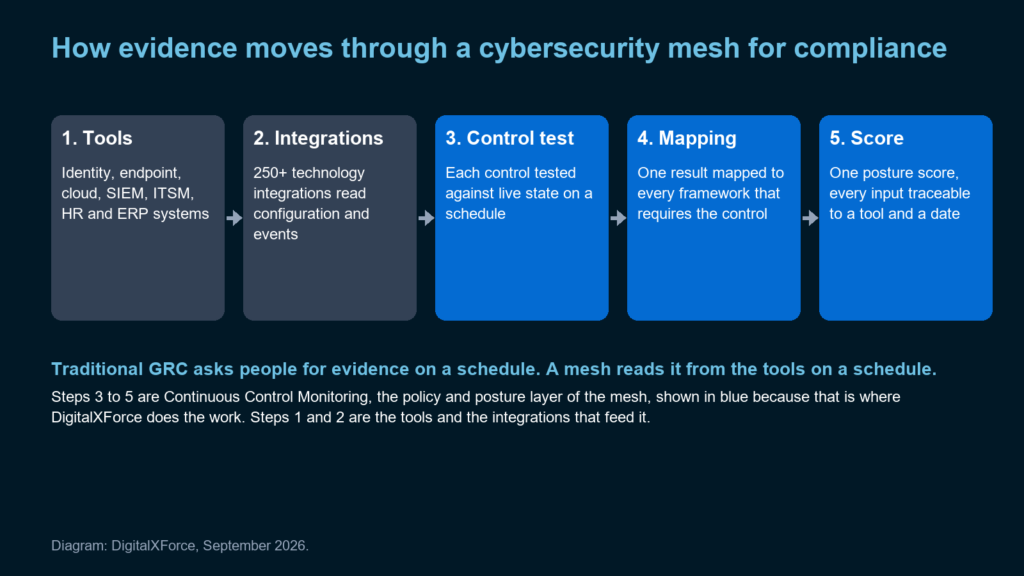
How evidence moves through a cybersecurity mesh for compliance, in five steps: tools, integrations, control test, framework mapping, score. Steps 3 to 5 are Continuous Control Monitoring, where DigitalXForce does the work

Cybersecurity Mesh Architecture for Compliance and Continuous Control Monitoring

Compliance programs collect evidence from people on a schedule. A cybersecurity mesh architecture reads it from the tools on a schedule, tests each control against live state, and maps one result to every framework that requires it. This article explains how that works, with the 37 frameworks DigitalXForce lists sorted by jurisdiction and a five-step evidence flow.

Cybersecurity Mesh Architecture for Compliance and Continuous Control Monitoring Read More »

Scroll to Top
Title banner reading Era of Automated Security Risk and Posture Management with the DigitalXForce logo beside a hand holding connected user icons and a report

Era of Automated Security Risk and Posture Management

Title banner reading Era of Automated Third Party Risk Management with Trust but Verify, with the DigitalXForce logo beside a hand holding connected user icons and a report

Era of Automated Third Party Risk Management: Trust but Verify

Title banner reading Era of Automated Security Plans, Standards, Policies and Procedures, with the DigitalXForce logo beside a hand holding connected user icons and a report

Era of Automated Security Plans, Standards, Policies and Procedures