DigitalXForce

Continuous Control Monitoring

Articles on Continuous Control Monitoring (CCM): testing controls against live evidence instead of point-in-time attestation, and what continuous assurance changes for risk teams.

Home » Continuous Control Monitoring

How to Start a Continuous Control Assurance (CCA) Program

Start a Continuous Control Assurance (CCA) program with a small set of high-risk controls that a system already enforces, write down the state each one should be in, connect the systems that hold the evidence, and run the whole loop from failed test to passing retest before adding frameworks. This guide covers ownership, the first controls, what stays manual, the phases, running beside ServiceNow or another GRC platform, and how to measure progress.

How to Start a Continuous Control Assurance (CCA) Program Read More »
Home » Continuous Control Monitoring

What Is an Assurance Gap, and How Do You Measure It?

An assurance gap is the time, or the set of controls, for which an organization has no current evidence that a control still operates as expected. This article shows how to measure it in controls and in days, what causes it in mature programs, how design and operating effectiveness relate to it, why stale evidence misleads, and how a Continuous Control Assurance (CCA) program reports it to executives.

What Is an Assurance Gap, and How Do You Measure It? Read More »

Home » Continuous Control Monitoring

How Automated Control Testing Decides Whether a Control Still Works

Automated control testing decides whether a control still works by comparing its actual state, read from the system that enforces it, with an expected state written down in advance. This article explains how the expected state is set, what happens when a test fails, how exceptions and compensating controls are handled and how to check that the test itself can be trusted.

How Automated Control Testing Decides Whether a Control Still Works Read More »

Home » Continuous Control Monitoring

How Do You Know Whether Security Controls Are Actually Working?

You know a security control is working when current evidence, read from the system that enforces it, passes a test against the state the control should be in. This article explains what working means, the 5 kinds of change that break controls, how to tell a control failure from an evidence failure, and how to check without waiting for the next audit.

How Do You Know Whether Security Controls Are Actually Working? Read More »

Home » Continuous Control Monitoring

Monitoring Detects. Continuous Control Assurance (CCA) Validates.

Continuous monitoring tells a team that something changed, and Continuous Control Assurance (CCA) tells it whether its controls still work after the change. This article draws the line between detecting and validating, shows where NIST draws the same line, and follows one change through the 4 steps of the DigitalXForce model.

Monitoring Detects. Continuous Control Assurance (CCA) Validates. Read More »

Home » Continuous Control Monitoring
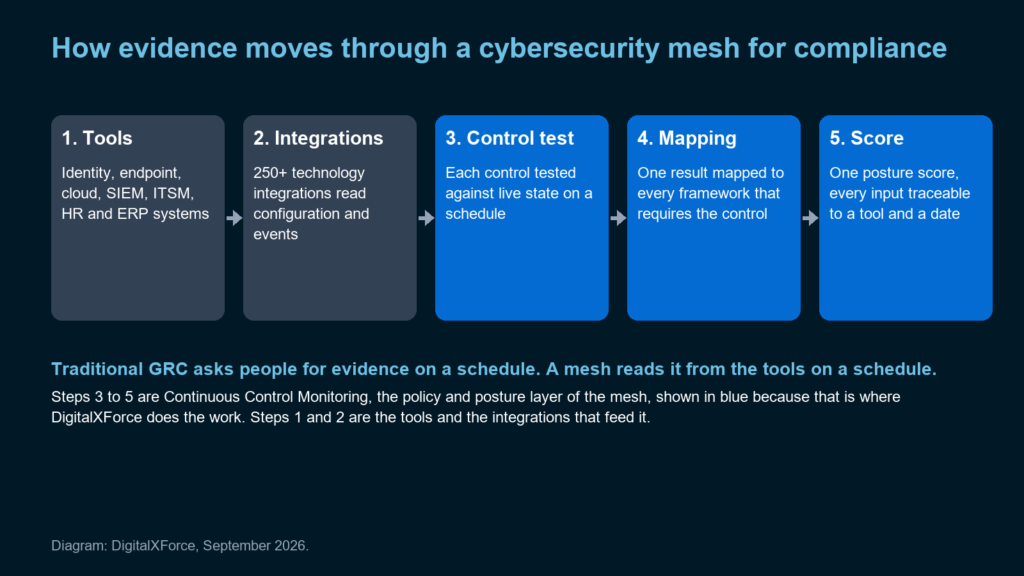
How evidence moves through a cybersecurity mesh for compliance, in five steps: tools, integrations, control test, framework mapping, score. Steps 3 to 5 are Continuous Control Monitoring, where DigitalXForce does the work

Cybersecurity Mesh Architecture for Compliance and Continuous Control Monitoring

Compliance programs collect evidence from people on a schedule. A cybersecurity mesh architecture reads it from the tools on a schedule, tests each control against live state, and maps one result to every framework that requires it. This article explains how that works, with the 37 frameworks DigitalXForce lists sorted by jurisdiction and a five-step evidence flow.

Cybersecurity Mesh Architecture for Compliance and Continuous Control Monitoring Read More »

Scroll to Top
Title banner reading Era of Automated Security Risk and Posture Management with the DigitalXForce logo beside a hand holding connected user icons and a report

Era of Automated Security Risk and Posture Management

Title banner reading Era of Automated Third Party Risk Management with Trust but Verify, with the DigitalXForce logo beside a hand holding connected user icons and a report

Era of Automated Third Party Risk Management: Trust but Verify

Title banner reading Era of Automated Security Plans, Standards, Policies and Procedures, with the DigitalXForce logo beside a hand holding connected user icons and a report

Era of Automated Security Plans, Standards, Policies and Procedures