In today’s threat-saturated cyber environment, your organization cannot afford to rely on legacy Governance, Risk, and Compliance (GRC) tools that were designed for slower, checklist-based environments. The velocity of attacks, increasing regulatory complexity, and expanding digital ecosystems require more than just periodic audits and fragmented workflows which legacy GRC tools offer.
If your security posture is still managed through spreadsheets, annual attestations and a GRC tool that never reads your security stack, you might already be operating with blind spots.
DigitalXForce is an Enterprise Trust, Risk, Security and Compliance Management (TRiSCM) platform that brings AI-powered automation, real-time risk posture visibility, GRC and cybersecurity together. But how do you know it’s time to switch?
Here are the top five signs you’ve outgrown your legacy GRC tool—and why DigitalXForce is the platform built for your future.
1. Your GRC Tool Can’t Keep Pace with Real-Time Threats
The Sign:
Your team is still relying on periodic audits, static risk assessments, or control validations that happen quarterly or annually.
The Problem:
Controls that are validated by sampling and attestation are checked on a periodic cycle. That leaves a gap between when a control breaks and when your team finds out, and attackers who exploit unpatched vulnerabilities in minutes do not wait for the next review. Archer, MetricStream and Optro, the company formerly called AuditBoard, now each describe continuous control monitoring of their own, so the useful question for any platform is which of your controls it tests against live data.
The DigitalXForce Advantage:
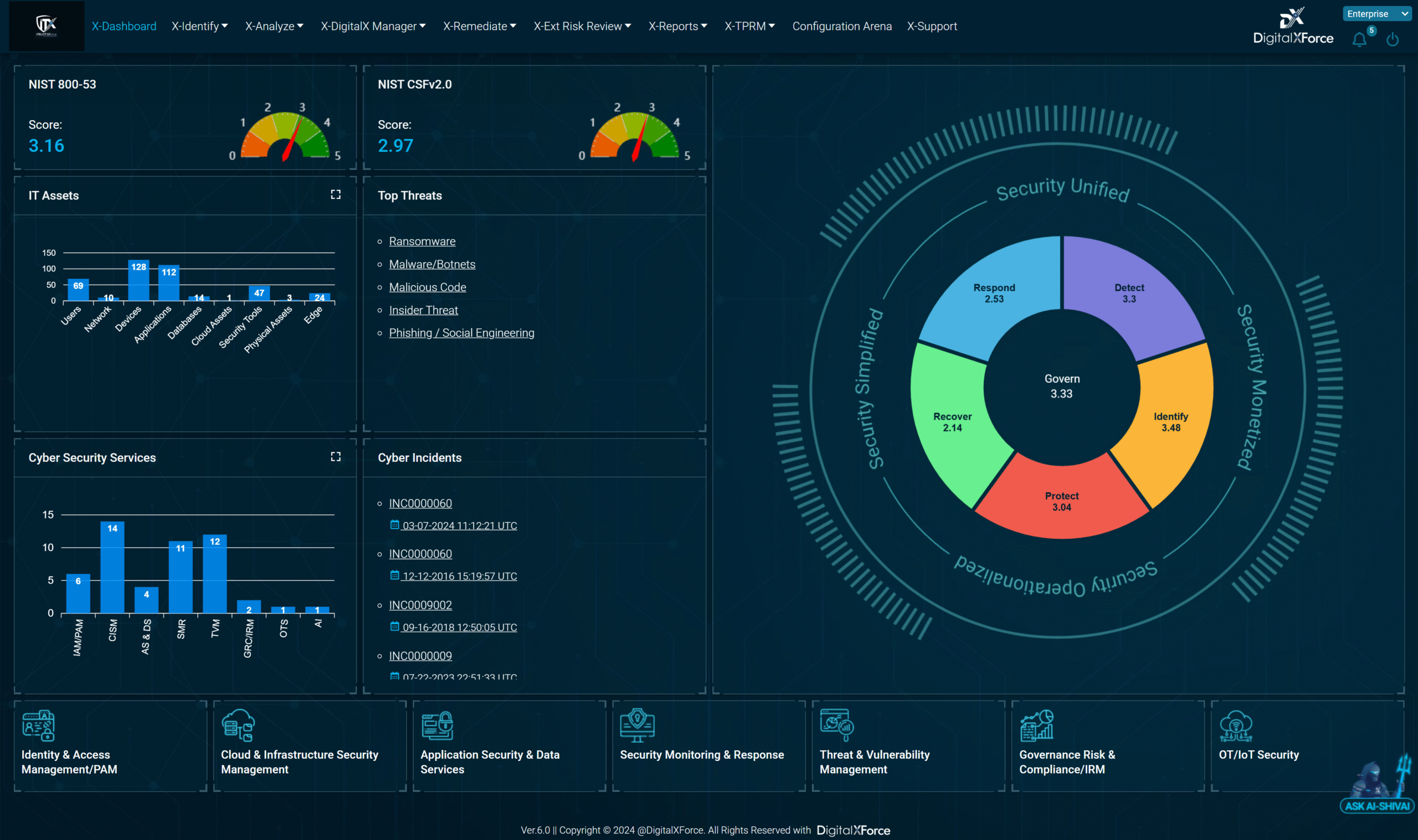
DigitalXForce offers real-time Continuous Control Monitoring (CCM), enabling organizations to detect drift or failure in security controls immediately. Backed by proprietary AI engines—AI JedAI and XForce GPT—DigitalXForce continuously monitors your environment, learns behavior patterns, and auto-prioritizes risks based on severity and exploitability. AI‑driven risk alerts notify teams the moment a control drifts or an exposure emerges.
DigitalXForce tests controls continuously between audits.
2. You’re Struggling with Fragmented Security and Compliance Workflows
The Sign:
Your security, compliance, and risk teams work in silos, with multiple tools and disjointed dashboards—each offering only a slice of your risk posture.
The Problem:
Many GRC programs were built around compliance frameworks (SOC 2, ISO, SOX) and keep security telemetry in separate tools. Vanta, Drata and OneTrust do connect to security tools, monitor controls with automated tests and watch vendors continuously, so the difference to look for is scope: whether posture, third-party risk and risk operations sit on the same record as compliance. When they sit in separate tools, the security and GRC teams each see only part of the picture.
The DigitalXForce Advantage:
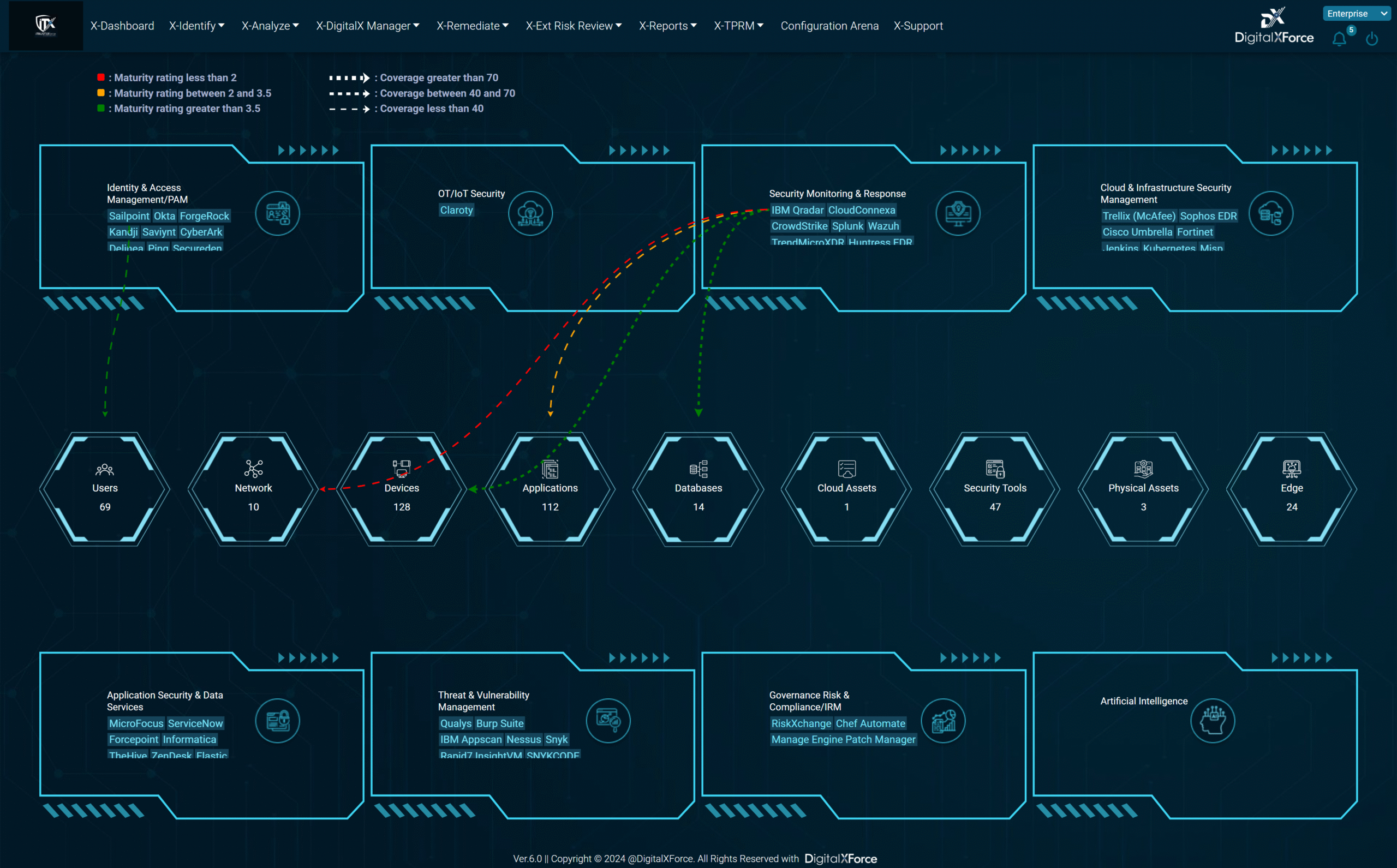
DigitalXForce was engineered for unified Security + GRC convergence. It brings together compliance evidence automation, risk quantification, threat exposure analysis, asset-level context, and control effectiveness in a single platform. This not only enhances visibility but also enables smarter decision-making.
DigitalXForce runs security posture and GRC on one platform.
With 250+ technology integrations and support for custom connectors, DigitalXForce unifies telemetry from IAM, SIEM, cloud, DevOps, ERP and CRM eliminating the need to juggle multiple tools and dashboards to assemble your security and compliance blueprint.
It also comes pre‑mapped to 50+ compliance frameworks (NIST, DORA, ISO, etc.), eliminating manual crosswalks.
DigitalXForce was named a Leader in the IDC MarketScape: Worldwide Governance, Risk, and Compliance Software Vendor Assessment, 2025, and a Leader in the IDC MarketScape: Worldwide Third-Party Risk Management Software 2026 Vendor Assessment.
3. Manual, Rules-Based Automation Is Slowing You Down
The Sign:
Your team spends excessive time building static rules, managing workflow configurations, or chasing evidence for audits.
The Problem:
Automation built on static rules handles predefined checklists well, and someone has to rewrite the rules each time a threat, a system or a control changes. Drata, Vanta and ServiceNow now each describe AI agents of their own, so ask every vendor what its AI decides, what it only drafts, and which evidence it reads.
The DigitalXForce Advantage:
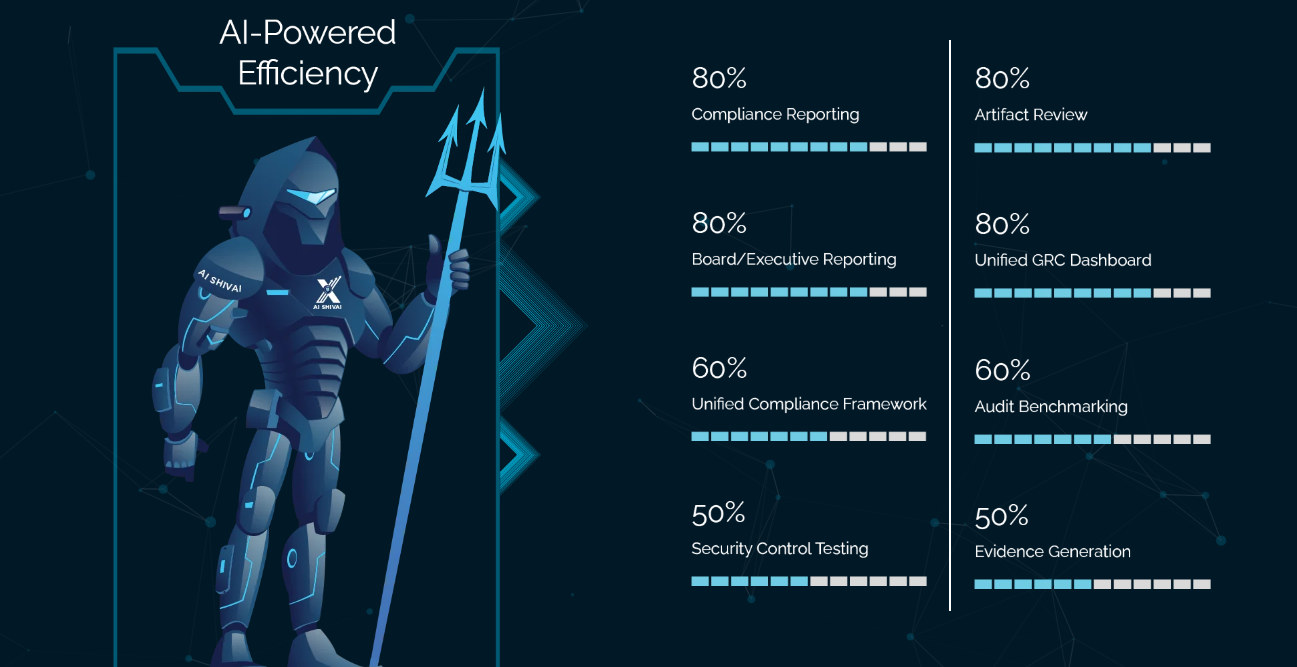
DigitalXForce deploys Advanced AI automation via AI JedAI and XForce GPT, which dynamically adjusts workflows, recommends remediations, and quantifies risk exposure in dollars—not just scores. Its AI can contextualize controls, reduce noise, and eliminate manual evidence gathering, accelerating compliance and improving your posture continuously.
Beyond eliminating manual rules, DigitalXForce includes automated risk alerts and notifications that trigger when controls drift or when new vulnerabilities are discovered. Audit evidence is automatically collected from connected systems and mapped to relevant frameworks, saving hours of chasing for evidence.
DigitalXForce runs two AI engines: AI JedAI analyzes and XForce GPT writes.
4. Your Risk Posture Isn’t Quantified or Prioritized
The Sign:
You don’t have a clear, continuous understanding of your cybersecurity risk—especially not in terms that executives understand, like financial impact.
The Problem:
Many risk registers still score risk as high, medium or low, which makes it hard for a CISO to defend a budget or show a return. Quantification itself is now common: MetricStream measures cyber risk in monetary terms with FAIR, and Optro quantifies likelihood and potential financial loss for IT risk. The question is whether the figures are recalculated from live control data or from the last assessment.
The DigitalXForce Advantage:
DigitalXForce translates technical risk into quantifiable financial terms, enabling true cyber risk quantification (CRQ). Its AI models integrate threat intelligence, asset sensitivity, control effectiveness, and business impact to generate executive-ready dashboards that show risk in monetary terms—essential for board reporting and insurance negotiations.
DigitalXForce quantifies cyber risk in dollars from live control data.
5. You’re Paying for Bloatware You Don’t Use
The Sign:
You’re locked into long contracts for bloated GRC suites with features your team doesn’t need—or can’t easily use.
The Problem:
A large GRC suite covers audit, compliance, policy, vendor and governance risk, and a team that needs only compliance tracking or third-party risk can end up configuring far more than it uses. The suites have moved here too: MetricStream offers low-code configuration, and Diligent says most customers go live on its third-party risk product in 10 days. Ask each vendor for the time and the services cost to reach the modules you will actually use.
The DigitalXForce Advantage:
DigitalXForce is modular, extensible, and API-driven. It is purpose-built for cybersecurity-first organizations that demand speed, flexibility, and ease of integration with their existing security stack. The platform offers guided onboarding and low-code configuration, so a team can start without a large professional services project.
DigitalXForce is modular and API-driven, and it starts from cybersecurity.
6. You Lack Continuous Vendor & Third‑Party Risk Insight
The Sign
Your vendor risk assessments happen annually or during onboarding, with little to no visibility into your suppliers’ ongoing security posture or emerging threats in your extended ecosystem.
The Problem
A third-party program built on annual questionnaires and manual scorecards works from security documentation that goes stale between reviews. The large platforms have added outside-in monitoring: OneTrust monitors third-party risk posture continuously with cybersecurity ratings, MetricStream assesses inherent risk continuously from external alerts, and Archer uses outside-in security ratings between reviews. What still differs is whether a change at a vendor lands on the same record as your own controls.
With supply chain attacks increasing by 742% year-over-year and threat actors specifically targeting vendor ecosystems, this periodic approach creates massive blind spots. When a critical vendor suffers a breach or their security controls degrade, you’re often the last to know—sometimes discovering it through news headlines rather than proactive monitoring.
The DigitalXForce Advantage
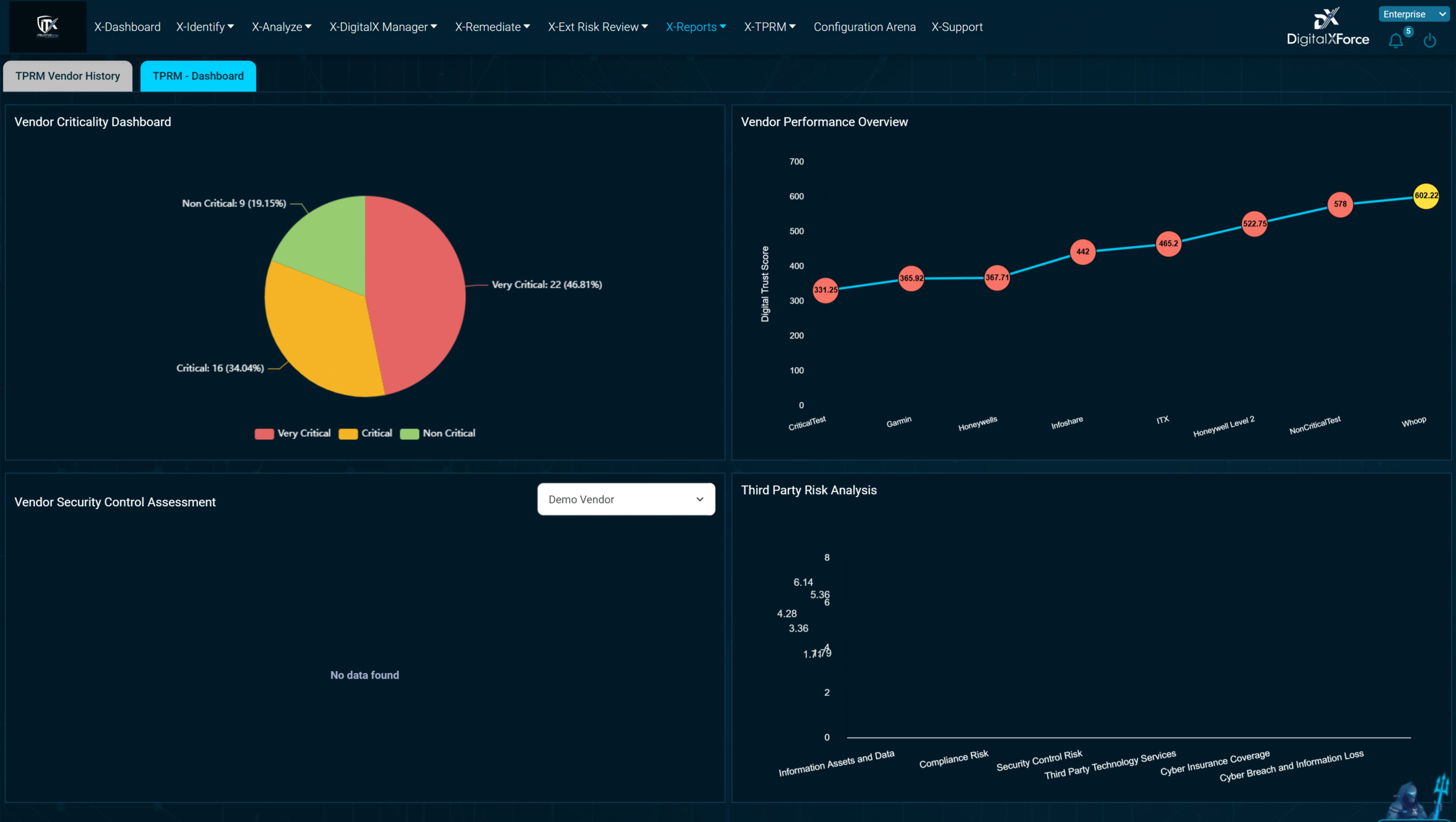
DigitalXForce delivers continuous vendor risk monitoring through its Digital Trust Portal and automated third-party risk intelligence. The platform continuously scans your vendor ecosystem for security posture changes, breach notifications, compliance drift, and emerging threats.
Powered by AI JedAI and XForce GPT, it automatically correlates vendor risk with your internal exposure, providing real-time risk scoring and impact assessment across your supply chain. When a vendor’s security posture changes or a new vulnerability affects your supply chain, you receive immediate alerts with contextual analysis and recommended actions.
DigitalXForce monitors vendor risk continuously instead of relying on periodic questionnaires alone.
With automated vendor risk management capabilities, DigitalXForce eliminates the manual overhead of chasing vendor documentation while providing the continuous assurance your extended ecosystem demands. From fourth-party risk visibility to automated breach impact analysis, DigitalXForce ensures your supply chain doesn’t become your weakest link.
Final Thoughts: The Time to Upgrade is Now
Modern security operations require real-time intelligence, automation at scale, and dynamic risk management that adapts to the threat environment. Traditional GRC platforms—designed decades ago—are struggling to keep up.
DigitalXForce isn’t just a GRC alternative; it’s a leap forward into enterprise security risk and posture management that’s continuous, intelligent, and actionable. From AI-powered automation to dollar-based risk quantification, DigitalXForce enables your security and compliance teams to move faster, detect earlier, and justify better.
With a dedicated Digital Trust Portal, built‑in security blueprint and automated vendor risk management, DigitalXForce gives you continuous assurance across your entire ecosystem.
Ready to Replace Your Legacy GRC Platform?
Request a personalized demo of DigitalXForce today.
Experience firsthand how DigitalXForce transforms your risk, compliance, and posture management with AI-driven clarity and control.
About DigitalXForce
DigitalXForce is the AI-native Enterprise Trust, Risk, Security and Compliance Management (TRiSCM) platform, and it unifies cybersecurity and GRC through AI-powered automation, real-time visibility and contextual intelligence. With deep integrations across security, compliance, and infrastructure, DigitalXForce helps organizations continuously monitor, quantify, and reduce their enterprise risk posture.
Do this once instead of every audit.
Every step above can be done by hand. DigitalXForce does them continuously, maps the result to 50+ frameworks once, and keeps the evidence current between audits. A 30 minute walkthrough on your own framework set shows what that removes from your calendar. Request a demo.