
The DigitalXForce “evidence-based scoring framework” is an attempt to bridge a critical gap: the absence of a standard metric for measuring and validating the trustworthiness of digital services. DigitalXForce introduces a quantifiable, standardized method for evaluating the reliability, security and compliance of the vendors and online platforms an organization relies on.
This article explores the growing need for trust metrics in the digital era, the limitations of existing trust validation methods, and how the Digital Trust framework enables businesses to mitigate risks and foster confidence.
The Current State of Digital Trust
According to ISACA’s latest report, “Organizations lack confidence. Only half (53%) are confident in the digital trustworthiness of their organization”. See: 2024 State of Digital Trust.
On the other hand, Deloitte reveals in a recent research that 85% of executives consider digital trust crucial for business success, yet only 40% believe they have adequate measures to assess it. This gap between necessity and capability creates a critical vulnerability in our increasingly digital world. See: Close the Trust Gap to Realize Business Value
Traditional security assessments provide only point-in-time snapshots rather than continuous, dynamic evaluation.
Why Digital Services Need an Evidence-Based Scoring Approach
An evidence-based scoring framework enables businesses to use standardized risk assessment, objective data-driven metrics, continuous monitoring and updates, and clear benchmarks for improvement.
Organizations desperately need these principles in digital services, where:
- According to Gartner’s 2022 Report, most companies take an average of 90 days to complete vendor due diligence. Organizations report difficulty in assessing vendor security posture.
- SecurityScorecard’s 2023 report reveals: “98% of organizations globally have relationships with at least one breached third-party. Approximately 10% of third-party vendors receive an F rating among organizations that earn an A rating for their own security posture.”
- UK National Cyber Strategy’s 2024 Cyber Security Breaches Survey reported that “Half of businesses (50%) and around a third of charities (32%) report having experienced some form of cyber security breach or attack in the last 12 months.”
- IBM’s Cost of a Data Breach Report shows the average breach cost reached $4.88 million in 2024.
The DigitalXForce Solution: Evidence-Based Vendor Scoring
Validating trustworthiness across diverse digital services is increasingly complex, as evolving risks challenge traditional methods. DigitalXForce brings the reliability and clarity to digital service evaluation through evidence-based scoring.
By quantifying digital interactions’ reliability, these scores make trust measurable, enhancing transparency and security in an interconnected digital ecosystem. This new approach delivers:
1. Real-Time Assessment
Each score is recalculated from current control evidence instead of from a point-in-time audit, so organizations see how their providers and partners stand now.
2. Full Evaluation
The framework examines multiple factors, including security posture and controls, compliance status, historical performance, incident response capabilities, and data protection measures.
3. Quantifiable Metrics
Our scoring framework provides clear numerical rankings that enable organizations to:
- Compare service providers
- Set minimum acceptable thresholds
- Track improvements over time
- Make data-driven decisions
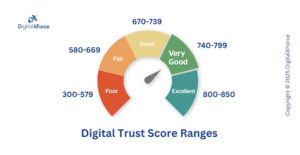
How DigitalXForce Scores Vendors and Service Providers
DigitalXForce uses the following advanced technologies to score vendors and service providers:
i. AI-Powered Analysis
Our proprietary AI JedAI and XForce GPT engines split the work: AI JedAI analyzes security tool outputs, compliance data, threat intelligence, performance metrics, and historical data, and XForce GPT writes the findings in plain language.
ii. Automated Risk Quantification
Through 250+ technology integrations, we enable real-time risk assessment, automated compliance mapping, continuous control validation, and dynamic security blueprints.
iii. Trust but Verify Approach
The DigitalXForce platform executes a rigorous verification process, including live validation of security controls, continuous monitoring of digital assets, automated policy verification, and real-time compliance testing.
Practical Applications of Evidence-Based Scores
Let’s consider some practical applications of these scores:
1. Vendor Risk Management
- Set minimum score requirements for vendors
- Monitor vendor security posture in real-time
- Make data-driven vendor selection decisions
- Automate vendor assessment processes
2. Service Provider Evaluation
- Compare security capabilities across providers
- Track provider performance over time
- Identify security gaps and improvements
- Simplify provider onboarding
3. Internal Security Assessment
- Monitor internal security posture
- Track security program effectiveness
- Identify areas for improvement
- Demonstrate security ROI
Is Digital Trust Scoring the Future of Digital Trust?
Digital services continue to grow, making standardized trust metrics critical. Our Digital Trust scoring approach advances:
- Digital trust assessment standardization
- Security evaluation automation
- Data-driven decision making
- Digital ecosystem security improvement
But, why is this important? A recent ISACA report reveals a stark reality: “82% of organizations say digital trust will be even more important in the next five years.” DigitalXForce gives organizations a way to measure digital trust instead of assuming it.
Organizations using DigitalXForce’s vendor scoring framework report a 40% reduction in vendor assessment time, 60% improvement in risk visibility, 30% decrease in security incidents, and significant improvement in board-level security reporting.
Conclusion
Digital Trust scoring transforms how organizations approach digital trust. Our framework equips organizations with essential tools to evaluate, monitor, and improve digital trust across their ecosystem. As digital transformation accelerates, this standardized approach to measuring digital trust becomes increasingly vital for business success.
At DigitalXForce, we enable organizations to make informed decisions about their digital services and partners by providing clear, quantifiable metrics and continuous monitoring. With the Digital Trust scoring framework, we are ultimately building a more secure and trustworthy digital ecosystem.
Book a Demo
What this looks like in practice.
Reading about continuous evidence is one thing. Watching a control get tested against live data from your own stack is another. A 30 minute walkthrough on your frameworks shows the difference. Request a demo.