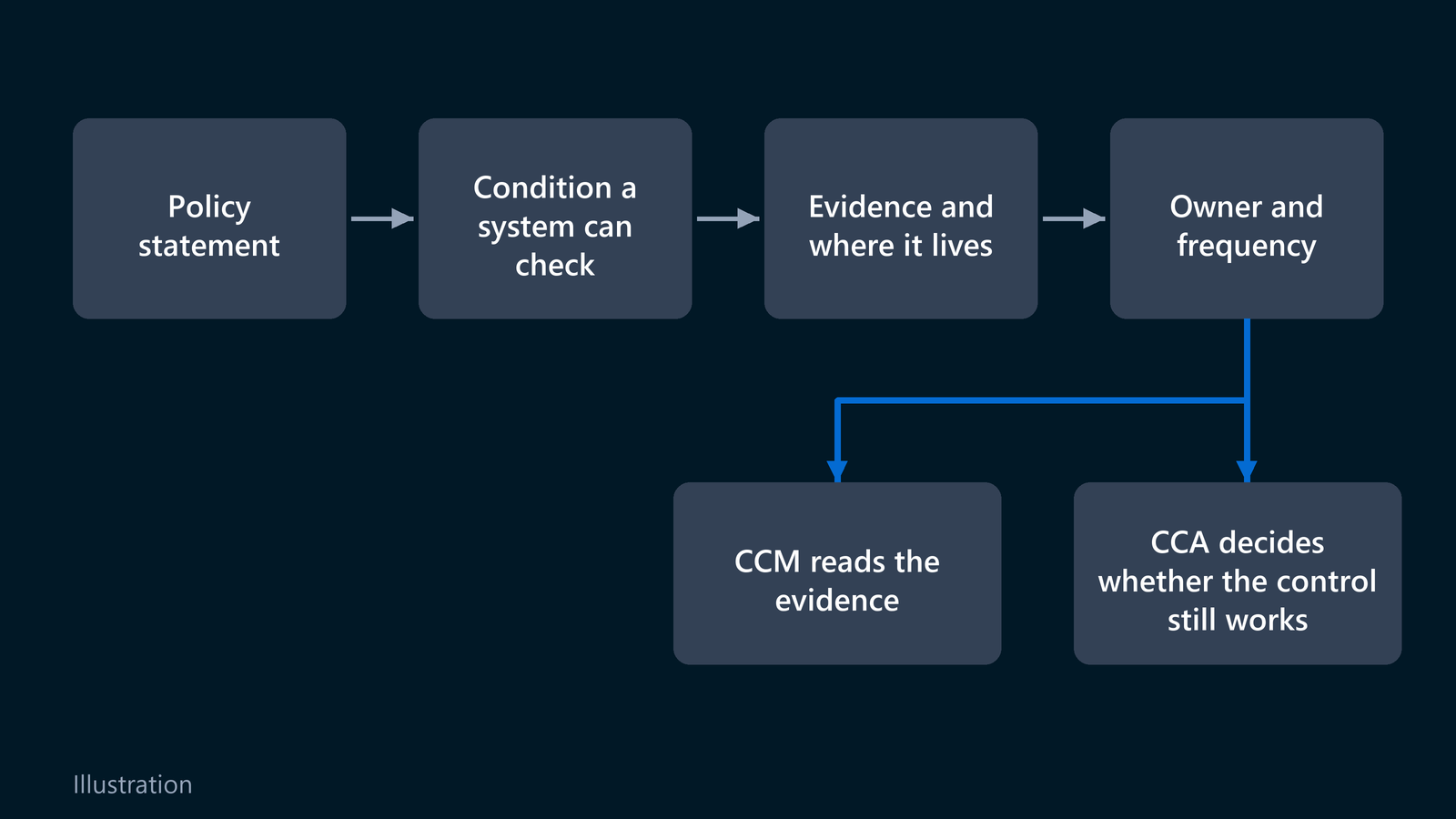
You move an AI governance policy into Continuous Control Monitoring by rewriting each policy statement as a condition a system can check. Name the evidence that proves the condition and the system that holds it, give the control an owner and set how often the test runs. Continuous Control Monitoring (CCM) monitors conditions, evidence and signals associated with controls, and Continuous Control Assurance (CCA) uses evidence, monitoring and validation to determine whether controls continue to operate as expected.
Why most policy statements cannot be monitored as written
A sentence such as “AI must be used responsibly” sets a direction, and no system can test it. Most AI policies are easy to comply with, since nothing in them can be checked. A statement becomes monitorable when it names something a system records, such as an owner field, an approval date, a gateway rule or a log entry.
CCM is a capability within CCA. Monitoring detects the change in the evidence, and CCA decides whether the control still works. The Continuous Control Monitoring page and the Continuous Control Assurance page explain the two layers in full.
Four parts turn a statement into a control
Each control needs a condition, its evidence, an owner and a frequency. The condition is the statement rewritten so that a system can answer yes or no. The evidence is the record that answers it, with the name of the system that holds the record. The owner fixes the control when it fails. How often the test runs depends on how fast the evidence can change, and each control in DigitalXForce has its own test frequency.
The examples below are illustrations rather than customer cases, and the right evidence depends on the tools an organization runs.
- The statement “every production AI system has a named owner” becomes the condition that no production AI system in the inventory is missing an owner, and the evidence is the owner field in the AI register.
- The statement “AI systems are approved before production” becomes the condition that every production system in the inventory has an approval record, and the evidence is the approval register checked against the inventory.
- The statement “a person reviews high-impact outputs” becomes the condition that each high-impact use records a named reviewer, and the evidence is the approval log in the application that uses the model.
Some statements leave no machine-readable trace. People assess those controls on a review cycle, and each one still needs an owner and a date.
What happens when a test fails
In DigitalXForce, approved use, prohibited use, data handling and human oversight are expressed as controls with tests in the AI TRiSCM and AI Risk Governance module. A guardrail that fails raises a risk in X-ROC, the XForce Risk Operations Center, with its evidence attached and an owner. X-ROC triages it, escalates it and tracks remediation to closure. The control is tested again when the fix is marked done, and the finding closes only when the retest passes.
Sometimes the organization decides to accept a gap for a while. A named person then records the decision with a reason and an expiry date, so the exception has an end date.
How the evidence holds up in an audit
Every test result is stored with the evidence it read and a timestamp, and the compliance dashboards show evidence age. Stale or missing evidence is recorded as stale or missing and never counted as a pass. Each AI control is mapped once to the NIST AI RMF, ISO/IEC 42001, the EU AI Act, the OWASP LLM Top 10 and MITRE ATLAS, so one evidence set serves the EU AI Act, ISO/IEC 42001 and the NIST AI RMF.
Auditors see the history of a control, with every result, exception, decision and retest kept with its evidence. The auditor decides whether to rely on it.
Where I would start
I would take three statements from the current AI policy and write the condition, the evidence, the owner and the frequency for each one. If a statement cannot be given all four, rewrite it before anyone tries to monitor it. The operationalize page shows where this work sits in a full Trust, Risk, Security and Compliance Management (TRiSCM) program.
Questions about moving an AI policy into Continuous Control Monitoring
What is the difference between Continuous Control Monitoring (CCM) and Continuous Control Assurance (CCA)?
Continuous Control Monitoring (CCM) monitors conditions, evidence and signals associated with controls. Continuous Control Assurance (CCA) uses evidence, monitoring and validation to determine whether controls continue to operate as expected, and CCM is a capability within CCA.
How often should an AI control be tested?
Each control has its own test frequency, set by how fast its evidence can change. Controls with no machine-readable evidence are assessed by people on a review cycle with an owner and a date.
What happens to stale evidence?
Stale or missing evidence is recorded as stale or missing and is never counted as a pass.
Do this once instead of every audit.
Every step above can be done by hand. DigitalXForce does them continuously, maps the result to 50+ frameworks once, and keeps the evidence current between audits. A 30 minute walkthrough on your own framework set shows what that removes from your calendar.