Continuous AI governance requires technical controls, since a policy can say what an AI system should do and only a tested control can show what the system did this week. AI governance is the set of policies, roles, controls and evidence an organization uses to decide which AI systems it runs, how they may be used and whether their controls keep working. A document cannot meet that last requirement.
What a policy can and cannot prove
A written AI policy sets intent, names owners and draws the lines on approved and prohibited use. That work matters, and every program I would build starts there. The difficulty begins the day after approval. A policy states what should happen, and it cannot show what a model, a copilot or an agent does while it runs. The model has not read the policy.
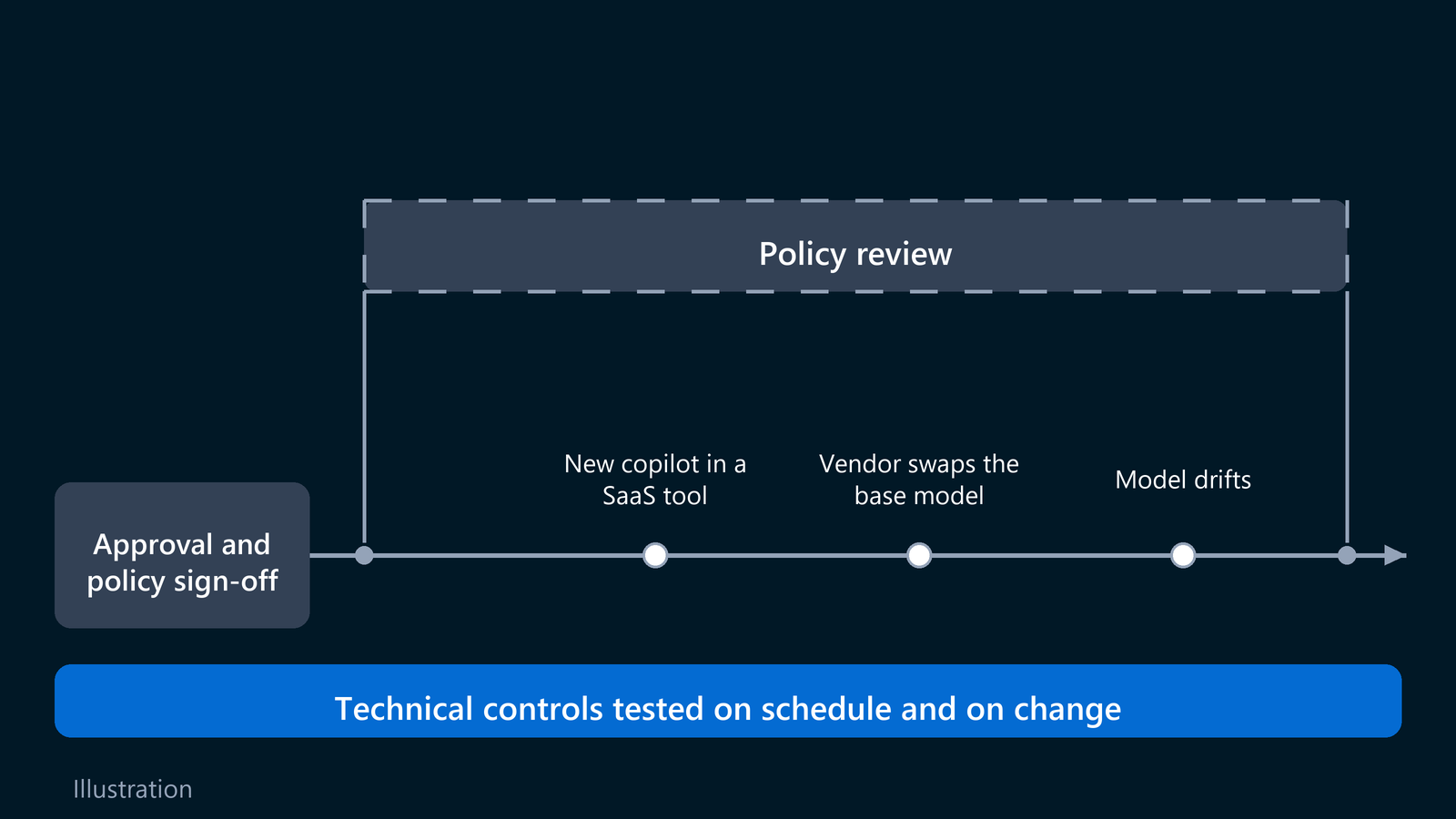
AI systems change between reviews
Three kinds of change arrive between policy reviews. A vendor swaps the base model behind a product the organization already approved. A copilot appears inside a SaaS tool that nobody listed as AI. A model in production drifts. Each change can break a control that passed at approval, and a review cycle finds it months later.
DigitalXForce calls this an assurance gap. An assurance gap is the time, or the set of controls, for which an organization has no current evidence that a control still operates as expected. AI widens the gap, since evidence gathered for last year’s approval says little about a model that changed last month.
What technical controls change
The AI TRiSCM and AI Risk Governance product page sets the two approaches side by side, and the table below reproduces its comparison.
| Question | Policy-based AI governance | AI governance run on technical controls |
|---|---|---|
| What AI is in scope? | Scope covers the systems teams declared. | Scope covers every system discovered, including shadow AI. |
| How often is a system assessed? | A system is assessed at approval and on request. | A system is assessed on a schedule and again when it changes. |
| How is a guardrail enforced? | A guardrail lives in a policy that people are asked to follow. | A guardrail is a control with a test, and a failure raises a risk with an owner. |
| How is compliance shown? | Compliance is a document assembled for the audit. | Evidence is collected as the controls are tested and mapped to the EU AI Act, ISO/IEC 42001 and the NIST AI RMF. |
| How is AI risk reported? | Risk is reported qualitatively, system by system. | Risk is a decomposable score that is trended, with its drivers named. |
The second row matters most. Assessment runs on a schedule and when the system changes, so a vendor’s swap of a base model in month four is caught in month four.
How the controls are validated
Continuous Control Monitoring (CCM) monitors conditions, evidence and signals associated with controls. CCM is a capability within CCA. Continuous Control Assurance (CCA) uses evidence, monitoring and validation to determine whether controls continue to operate as expected.
In DigitalXForce, every test result is stored with the evidence it read and a timestamp, and the compliance dashboards show evidence age. A failed guardrail raises a risk in X-ROC, the XForce Risk Operations Center, with its evidence attached, and the finding closes only when a retest passes. The AI module runs on the same data layer as the other 14 modules, so an AI control failure lands in the same risk register as every other failure.
What stays with people
Technical controls leave the judgment with people. People decide the scope, the owners, the risk appetite and what counts as a pass. Whether a control is well designed stays a human judgment. An analyst reviews AI output before anyone relies on it, and every conclusion links back to the evidence it used.
Where I would start
I would pick the AI system that matters most to the business and ask one question about it: what evidence, dated this month, shows its controls still work? If the answer is a policy and an approval memo, start the first technical control on that system. The CCA page explains how a control result is validated, and the What is TRiSCM page explains where AI fits in Trust, Risk, Security and Compliance Management (TRiSCM).
Questions about continuous AI governance
Why is a policy not enough for AI governance?
A policy states what should happen, and it cannot show that controls behave that way while AI systems run. Continuous Control Assurance (CCA) uses evidence, monitoring and validation to determine whether controls continue to operate as expected.
What is an assurance gap in AI governance?
An assurance gap is the time, or the set of controls, for which an organization has no current evidence that a control still operates as expected. For AI it opens whenever a model, a vendor or a use changes between reviews.
Do technical controls replace the AI policy?
They do not. The policy sets intent and owners, and technical controls test whether the systems follow it.
What this looks like in practice.
Reading about continuous evidence is one thing. Watching a control get tested against live data from your own stack is another. A 30 minute walkthrough on your frameworks shows the difference.