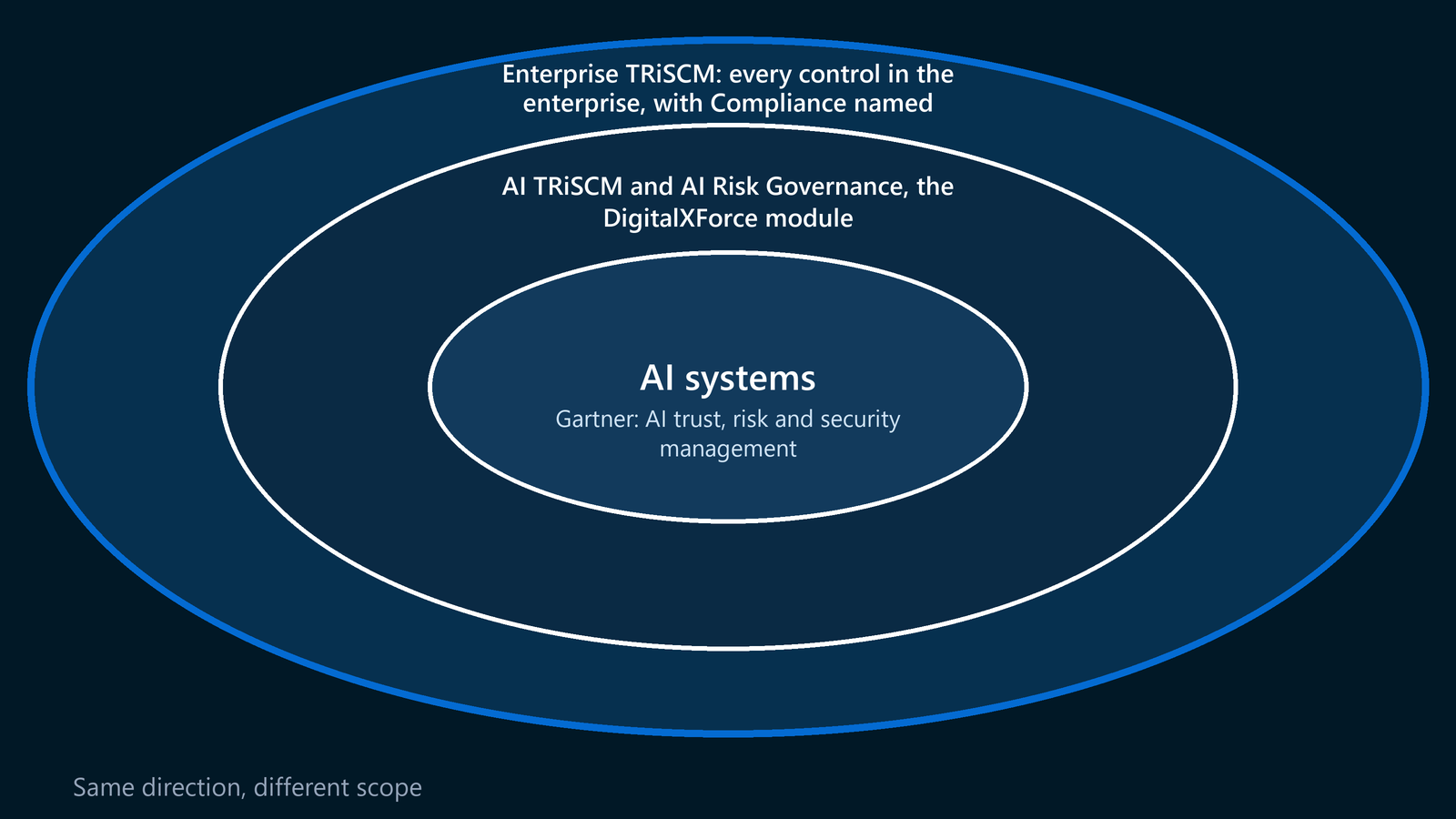
Gartner uses the name AI trust, risk and security management for the discipline of governing AI systems: inventory the AI systems, understand their risk, secure them and govern their use. TRiSCM™, or Trust, Risk, Security and Compliance Management, is a category of enterprise software defined by DigitalXForce that converges automated governance, risk and compliance with security posture management into a single real-time system, replacing periodic control validation with continuous control assurance. The two terms differ in scope, and the extra letter in ours is Compliance.
The two terms look alike and cover different ground
Gartner’s term is about AI systems. TRiSCM covers the whole enterprise control environment, and AI is one domain inside it. A model, a copilot or an agent is an asset with controls on its data, its model and its use, and those controls sit beside the access reviews, backups and cloud configurations every other team already answers for.
DigitalXForce does not use one term in place of the other. We use TRiSCM for our category and leave Gartner’s name to Gartner. On our site, Gartner’s abbreviation appears only on the AI TRiSCM product page and in the glossary, where the contrast matters.
What the C adds in practice
Compliance adds two things to AI governance. The first is mapping. Each AI control is mapped once to the frameworks an organization reports under, and the AI TRiSCM and AI Risk Governance module covers the NIST AI RMF, ISO/IEC 42001, the EU AI Act, the OWASP LLM Top 10 and MITRE ATLAS. One evidence set then serves the EU AI Act, ISO/IEC 42001 and the NIST AI RMF without a second collection. Collecting the same evidence twice for two regulators has never been anyone’s favorite part of the year.
The second is evidence that stays current as the model changes. Continuous Control Assurance (CCA) uses evidence, monitoring and validation to determine whether controls continue to operate as expected. Continuous Control Monitoring (CCM) monitors conditions, evidence and signals associated with controls, and CCM is a capability within CCA. Every test result is retained with its timestamp and its source, so the audit pack is built from a record that already exists.
How the AI module connects to the rest of the platform
AI TRiSCM and AI Risk Governance is the DigitalXForce module for AI asset discovery, assessment and mapping to NIST AI RMF, ISO/IEC 42001, the EU AI Act, the OWASP LLM Top 10 and MITRE ATLAS. It runs on the same data layer as the other 14 modules.
Since the layer is shared, an AI problem has a clear place to go. A failed guardrail raises a risk in X-ROC, the XForce Risk Operations Center, with its evidence attached and an owner. AI risks sit in the enterprise risk register next to every other risk. Vendors that supply models are assessed in the third-party risk module, and the posture of the systems the AI runs on comes from X-SPM. X-SPM is Extended Security Posture Management, the DigitalXForce capability that scores security posture across the enterprise and its vendors from the same control data.
Two mix-ups I would avoid
The first mix-up is reading TRiSCM as a Gartner category. It is a term DigitalXForce defined, and nothing in it claims Gartner’s endorsement.
The second is reading TRiSCM as third-party risk and supply chain management. On DigitalXForce pages TRiSCM always means Trust, Risk, Security and Compliance Management, and third-party risk is one of the areas an Enterprise TRiSCM program covers.
Certification stays with the accredited auditor or certification body, and DigitalXForce hands that auditor the mapped controls and the evidence.
Questions about Gartner’s AI category and Trust, Risk, Security and Compliance Management (TRiSCM)
How does Trust, Risk, Security and Compliance Management (TRiSCM) differ from Gartner’s AI trust, risk and security management?
Gartner’s term names a discipline for AI systems. TRiSCM is a category defined by DigitalXForce that covers the whole enterprise control environment, names Compliance as one of its four parts and treats AI as one domain.
What is AI TRiSCM?
AI TRiSCM and AI Risk Governance is the DigitalXForce module for AI asset discovery, assessment and mapping to NIST AI RMF, ISO/IEC 42001, the EU AI Act, the OWASP LLM Top 10 and MITRE ATLAS. It is how DigitalXForce runs AI governance in operation, with compliance mapping and Continuous Control Assurance added.
Does DigitalXForce certify AI systems?
It does not. Certification stays with the accredited auditor or certification body, and DigitalXForce gives that auditor the mapped controls and the evidence.
What this looks like in practice.
Reading about continuous evidence is one thing. Watching a control get tested against live data from your own stack is another. A 30 minute walkthrough on your frameworks shows the difference.