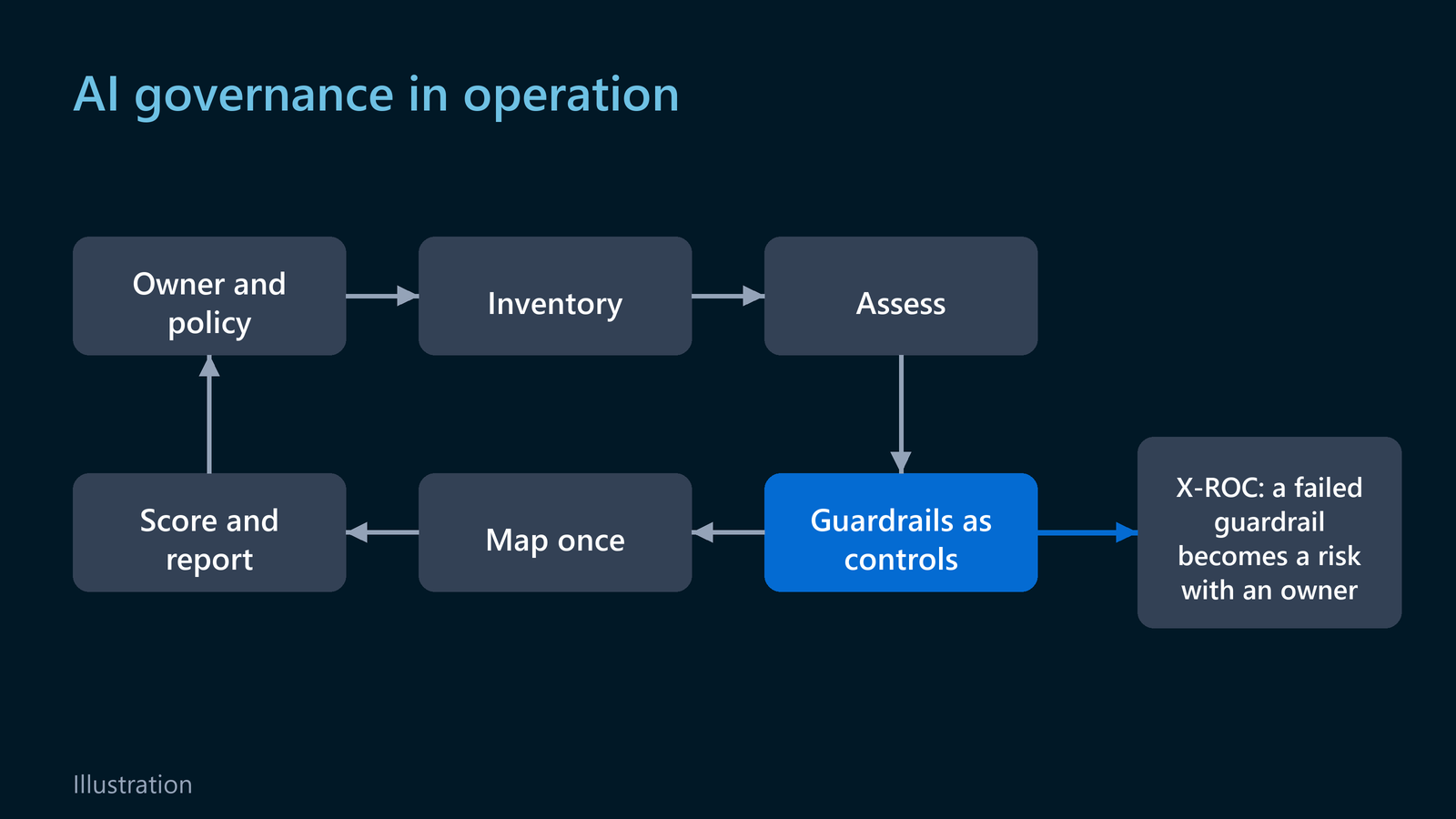
You run AI trust, risk and security management by turning it into controls that are tested against live AI systems. Name an owner for AI risk, inventory every AI system, assess each one on a schedule and on change, express the policy guardrails as controls with tests, and map those controls once to the frameworks you report under. A failed guardrail then becomes a risk with an owner, and the board sees a trend backed by evidence.
Gartner uses the name AI trust, risk and security management for this discipline. At DigitalXForce we run it through the AI TRiSCM and AI Risk Governance module, where TRiSCM stands for Trust, Risk, Security and Compliance Management. AI governance is the set of policies, roles, controls and evidence an organization uses to decide which AI systems it runs, how they may be used and whether their controls keep working.
Put an owner and a policy in place before discovery
Bring AI systems in once an AI policy and an owner for AI risk exist. Discovery without an owner turns up problems that nobody is accountable for. A long inventory with no owner is mostly a reading list.
The owner decides the scope, the risk appetite for AI and what counts as a pass. Those stay human decisions in any program I would design.
Inventory what runs, including what nobody declared
The AI TRiSCM module discovers models, copilots, agents and RAG stores across cloud services, code repositories, CI/CD pipelines, containers, model endpoints, internal LLMs, third-party SaaS with embedded AI, prompt libraries and data pipelines. Shadow AI appears in the inventory the same way as sanctioned AI. Governance then covers what exists, so a copilot that a team forgot to declare still shows up on the list.
An AI system is approved before it goes into production, and the inventory shows whether that happened.
Assess each system on a schedule and when it changes
Each AI system is assessed for the risks specific to it. Adversarial risk covers prompt injection and model extraction. Data leakage covers sensitive data entering or leaving the model. Model integrity covers bias, drift and hallucination, along with the code and supply chain risk around the model.
Assessment runs on a schedule and again when the system changes, so a vendor that swaps a base model in month four is caught in month four.
Write the guardrails as controls with tests
Approved use, prohibited use, data handling and human oversight are expressed as controls with tests, and the organization’s own AI policy is enforced the same way. A guardrail that fails raises a risk in X-ROC, the XForce Risk Operations Center, with its evidence attached and an owner. X-ROC triages it, escalates it and tracks remediation to closure, and the control is tested again when the fix is marked done.
This step is where control assurance does its real work. Continuous Control Assurance (CCA) uses evidence, monitoring and validation to determine whether controls continue to operate as expected. The Continuous Control Assurance page explains how a result is validated before anyone relies on it.
Map each control once and keep one evidence set
AI controls are mapped once to the NIST AI RMF, ISO/IEC 42001, the EU AI Act, the OWASP LLM Top 10 and MITRE ATLAS. Every test result is retained with its timestamp and its source. One evidence set serves the EU AI Act, ISO/IEC 42001 and the NIST AI RMF, so a second regulator does not mean a second collection.
Score the risk and report the trend
Each AI system carries a risk score built from its use-case tier, data sensitivity and autonomy, adjusted by the coverage and currency of its controls. The score breaks down into its parts, so when it moves the reason is named, such as a lapsed control or a system that gained autonomy. AI risks sit in the enterprise risk register next to every other risk.
XForce GPT writes the executive narrative of what AI is in use, what changed and what is outstanding. An analyst reviews AI output before anyone relies on it, and every conclusion links back to the evidence it used.
How a program usually starts
DigitalXForce’s standard proof of value runs for 4 weeks on the customer’s own systems and frameworks. Connectors are configured in week 1, the attack surface and External Risk View are set up in week 2, the first assessments run in week 3, and they are reviewed with the customer in week 4. The operationalize page sets out the order for the whole Trust, Risk, Security and Compliance Management (TRiSCM) program, of which AI is one part.
Questions about running AI governance in operation
Who should own AI governance in operation?
One named owner for AI risk should hold it before discovery starts, inside a program that one executive owns. Control owners fix what fails in their area, and internal audit reviews the program independently.
Does the module find AI that teams did not declare?
It does. Shadow AI appears in the inventory the same way as sanctioned AI, across cloud, code, pipelines, containers, model endpoints, RAG stores and third-party tools.
Who certifies the AI systems?
The accredited auditor or certification body does. DigitalXForce hands that auditor the mapped controls and the evidence.
Do this once instead of every audit.
Every step above can be done by hand. DigitalXForce does them continuously, maps the result to 50+ frameworks once, and keeps the evidence current between audits. A 30 minute walkthrough on your own framework set shows what that removes from your calendar.