TRiSCM™, or Trust, Risk, Security and Compliance Management, is a category of enterprise software defined by DigitalXForce that converges automated governance, risk and compliance with security posture management into a single real-time system, replacing periodic control validation with continuous control assurance. The full reference, with every comparison table, sits on the What is TRiSCM page. The definition is long, so I will show it working on a single control.
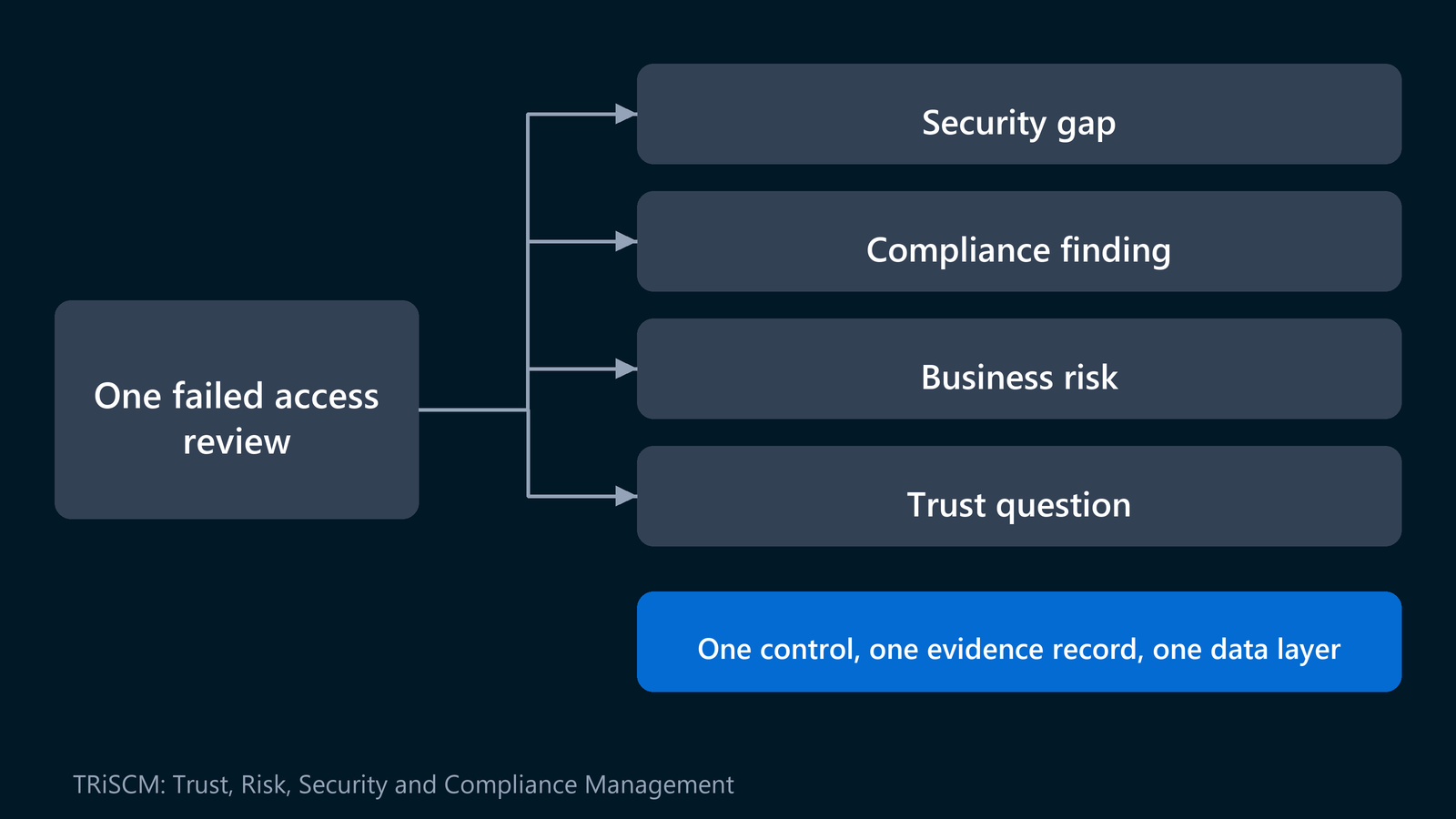
One failed access review gets four answers today
Take an access review that fails. It is a security gap, a compliance finding, a business risk and a question of trust at the same time. In most organizations four separate tools hold those four views. Each tool has its own evidence and its own reporting cycle, and the person accountable to the board reconciles them by hand.
So the board hears four answers about one control. That is three more than any board has asked for.
TRiSCM gives the board that one answer. Trust, risk, security and compliance rest on the same controls and the same evidence, so DigitalXForce built a platform in which they share one data layer and one set of controls.
What each word in TRiSCM commits the platform to
Each word in the name is a promise. Trust is the outcome the platform produces, risk is what it measures, security is what it observes, and compliance is what it proves. The C stands for Compliance, and DigitalXForce always spells out all four words.
A regulator, an auditor or a customer asks for proof against a named requirement, with a date on the evidence. In TRiSCM each control is mapped once to every requirement it satisfies across 50+ compliance frameworks, so one test result counts toward every requirement the control satisfies.
How the work moves from a signal to a board decision
DigitalXForce sums up the model in four sentences. Monitoring detects. CCA validates. Enterprise TRiSCM connects. Digital Trust translates.
Continuous Control Monitoring (CCM) monitors conditions, evidence and signals associated with controls. CCM is a capability within CCA. Continuous Control Assurance (CCA) uses evidence, monitoring and validation to determine whether controls continue to operate as expected. Enterprise TRiSCM connects control assurance to Trust, Risk, Security and Compliance across the enterprise. Digital Trust translates connected assurance and risk evidence into an enterprise-level view for decision-makers.
Back to the access review. Monitoring picks up the signal that the review failed. CCA records the control as failing, and a failed control opens a finding. The 15 DigitalXForce modules share one data layer, so that one failed result reaches the compliance view, the posture view and the risk register at the same time. The control is tested again when the fix is marked done, and the finding closes only when the retest passes.
Every step leaves a record. Each input can be traced to the tool it came from, the control it belongs to and the date it was read, and an auditor or a board member can check that trace.
How TRiSCM differs from GRC, IRM and posture management
Traditional GRC was built to document policies, risks and controls, and it validates controls at intervals. Integrated Risk Management (IRM) is organized around the risk register. Security posture management answers whether systems are configured the way the security team intends, and on its own it does not say which requirement or business risk a misconfiguration affects. TRiSCM is organized around the control and the evidence that proves it.
Two things stay with people. TRiSCM cannot decide whether a control is well designed, and it does not replace the audit. The comparison table on the What is TRiSCM page sets the four approaches side by side.
Where AI fits in TRiSCM
AI is one domain of the enterprise control environment. The AI TRiSCM and AI Risk Governance module brings AI systems into the same chain, on the same data layer as the other 14 modules. A model that drifts out of policy is then a failed control with an owner, the same as any other.
Where I would start
I would start with one control that a system enforces, such as multifactor authentication on administrator accounts, and trace it from the requirement to the evidence. Write down who owns it, when it was last tested, what proves it and which frameworks it counts toward. If that trace crosses two tools and takes days, you have found the problem TRiSCM was built to solve. The operationalize page lays out the full order for a program.
DigitalXForce was named a Leader in the IDC MarketScape: Worldwide Third-Party Risk Management Software 2026 Vendor Assessment (IDC #US53007725, September 2026). The IDC research page lists the recognition.
Questions about Trust, Risk, Security and Compliance Management (TRiSCM)
What does the C in Trust, Risk, Security and Compliance Management (TRiSCM) stand for?
The C stands for Compliance. TRiSCM expands to Trust, Risk, Security and Compliance Management, and all four words are part of the term.
Is Trust, Risk, Security and Compliance Management (TRiSCM) a Gartner term?
It is not. TRiSCM is a term defined by DigitalXForce. Gartner uses the name AI trust, risk and security management for governing AI systems, and TRiSCM covers the whole enterprise control environment, with AI as one domain.
Does Trust, Risk, Security and Compliance Management (TRiSCM) replace the audit?
It does not. It gives the auditor a current, timestamped record to test, and the audit opinion stays with the auditor.
What this looks like in practice.
Reading about continuous evidence is one thing. Watching a control get tested against live data from your own stack is another. A 30 minute walkthrough on your frameworks shows the difference.